
A chiller that has lost part of its capacity often shows no alarm at all. The leaving water temperature simply drifts above the setpoint, first on warm afternoons and then all day. The table below is the checklist we work through. Each line has a reading that confirms or excludes the cause, so the search does not depend on guesswork.
The checklist
| Cause | Reading that points to it | Repair |
|---|---|---|
| Dirty condenser coil | Condensing temperature far above outdoor air temperature | Coil cleaning from the inside out |
| Refrigerant shortage | Low suction pressure, high superheat, low subcooling | Leak search, repair, recharge by weight |
| Low water flow | Large temperature difference across the evaporator | Strainer, pump, balancing valves |
| Fouled evaporator | Growing gap between evaporating and leaving water temperature | Chemical cleaning of the water side |
| Wrong glycol concentration | Refractometer reading above the design value | Correct the mixture |
| Capacity control fault | Current shows that a compressor or stage is not loading | Repair valve, slide or controller output |
| Load has grown | Measured capacity equals the data sheet, yet it is not enough | Buffer tank, second unit, rental |
Air side: the condenser
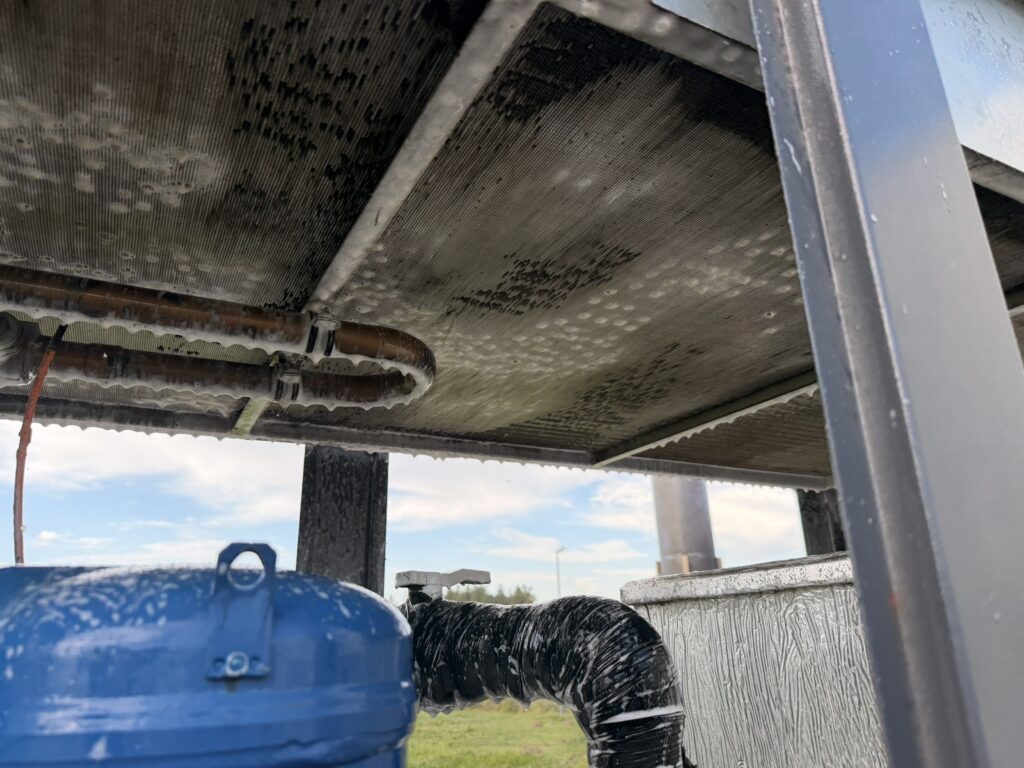
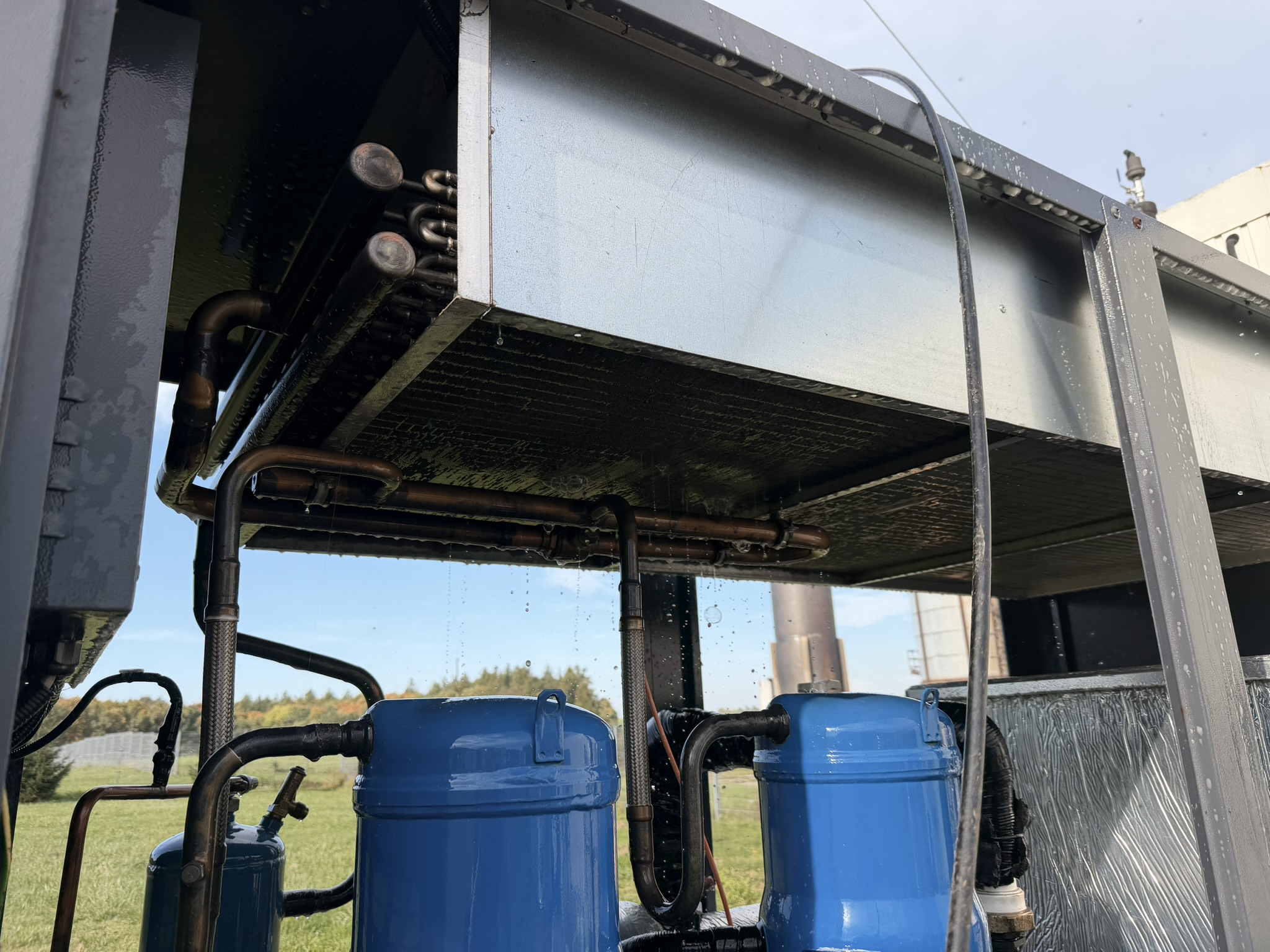
On an air cooled chiller the coil is the first thing to look at, also from underneath and from the inside, where dirt is hidden from view. A blocked coil raises the condensing pressure, cuts capacity and increases power draw at the same time. Our note on what a dirty condenser costs gives a worked example, and the service is described under condenser cleaning.
Refrigerant side: charge and expansion
We read suction and discharge pressure, superheat and subcooling on every circuit and compare the circuits with each other. A circuit that is short of refrigerant uses only part of its evaporator. An expansion valve that does not open far enough produces a similar picture with normal subcooling. The difference matters, because one needs a leak repair and the other a valve or driver. See refrigerant leak repair.
Water side: flow, fouling and glycol
Flow is checked from the pressure drop across the evaporator and the temperature difference between inlet and outlet. Too little flow makes the controller reduce capacity to protect the evaporator from freezing. Deposits on the water side act as insulation. Glycol deserves its own measurement: every extra ten percent lowers heat transfer and raises the pressure drop, so a mixture that is stronger than the design value quietly takes capacity away. We adjust it after a glycol test.
Controls: is the whole machine working?
A compressor locked out by an old alarm, an unloader stuck open or a demand limit left active after commissioning can hold the unit at part load for months. The controller display looks calm. Current per compressor and the stage status tell the truth. We step through the stages one by one and compare them with the manufacturer data.
When the chiller is simply too small
If measured capacity matches the data sheet, the chiller is healthy and the process has outgrown it. A capacity measurement from flow and temperature difference settles this within an hour. The options then are a buffer tank for short peaks, a second chiller or a rental unit for the season.
What a diagnosis costs
On site diagnosis starts at 800 EUR net, a working hour is 115 EUR net and travel 0.75 EUR net per km. You receive the readings, the calculated capacity and a list of actions in order of effect. Our crews travel from Wałsnów and Szczecin in Poland. Regular checks following the maintenance checklist prevent most of the causes above.
Quick answers
Why is there no alarm when the chiller cannot hold the setpoint?
Will a lower setpoint help?
What can I check myself?
How long does the diagnosis take?
Send us the model, serial number, setpoint and current water temperatures through the contact form or to info@chillerserwis.com.