
Convert cooling capacity, pressure, temperature and flow between the units used in refrigeration: kW, TR, BTU/h, kcal/h, bar, psi, kPa, MPa, °C, °F, K, m³/h, l/s, l/min and gpm.
Refrigeration unit converter
Pressure conversions keep the reference: gauge stays gauge, absolute stays absolute. 1 TR = 12,000 BTU/h = 3.5169 kW; 1 kcal/h = 1.163 W; 1 US gallon = 3.7854 l.
Units you meet in refrigeration
Chiller data sheets, service manuals and controllers come from different countries and different decades, so the same quantity appears in several units. A unit from an American manufacturer lists capacity in tons and pressures in psi, an older European one in kcal/h, and a current one in kW and bar. The converter above handles the units that come up most often in chiller and refrigeration work. Choose the quantity, enter the value and the unit, and the tool shows all other units at once.
Cooling capacity
The kilowatt is the SI unit and the one used in Europe. The ton of refrigeration (TR) comes from the heat needed to melt one short ton of ice in 24 hours and equals 12,000 BTU/h or 3.517 kW. Older European documentation uses kcal/h, where 1,000 kcal/h is 1.163 kW. When you compare a data sheet in TR with one in kW, also check the rating conditions, which often differ between American and European standards.
| Unit | In kW | Where you see it |
|---|---|---|
| 1 TR | 3.517 | American and Asian data sheets |
| 1,000 BTU/h (1 MBH) | 0.293 | Split and packaged units, US documentation |
| 1,000 kcal/h | 1.163 | Older European chillers and process equipment |
| 1 hp | 0.746 | Compressor motor power, not cooling capacity |
Do not confuse compressor horsepower with cooling capacity. A compressor of 10 hp can deliver very different capacities depending on the refrigerant and the operating conditions.
Pressure
Refrigeration gauges in Europe read in bar, in America in psi. 1 bar is 14.504 psi, 100 kPa or 0.1 MPa. The important trap is the reference: most gauges and many controllers show gauge pressure, which is the pressure above the surrounding atmosphere, while property tables and some electronic controllers work with absolute pressure. The difference is about 1.013 bar or 14.7 psi at sea level. The converter keeps the reference unchanged, so convert gauge into gauge and absolute into absolute. For saturation temperatures, use our refrigerant pressure-temperature table, which works in bar gauge.
For water circuits, pressure differences are often given in metres of water column or kPa. A pump head of 10 m is about 98 kPa or 0.98 bar.
Temperature and temperature difference
Temperatures convert with an offset: °F = °C x 1.8 + 32, and K = °C + 273.15. A temperature difference converts without the offset: 5 K equals 5 °C difference and 9 °F difference. Mixing these two up is a common source of error when reading superheat or a water temperature difference from American documentation, which is why the converter has a separate option for differences.
Volume flow
Chilled water flow is given in m³/h in most European documentation, in l/s on many data sheets and in US gallons per minute in American ones. 1 l/s is 3.6 m³/h, and 1 US gpm is 0.227 m³/h. Note that the UK gallon is about 20 % larger than the US gallon. For a fast estimate, a chiller with 5 K temperature difference needs about 0.172 m³/h of water per kW, or roughly 0.76 US gpm per kW.
Reading controllers and data plates
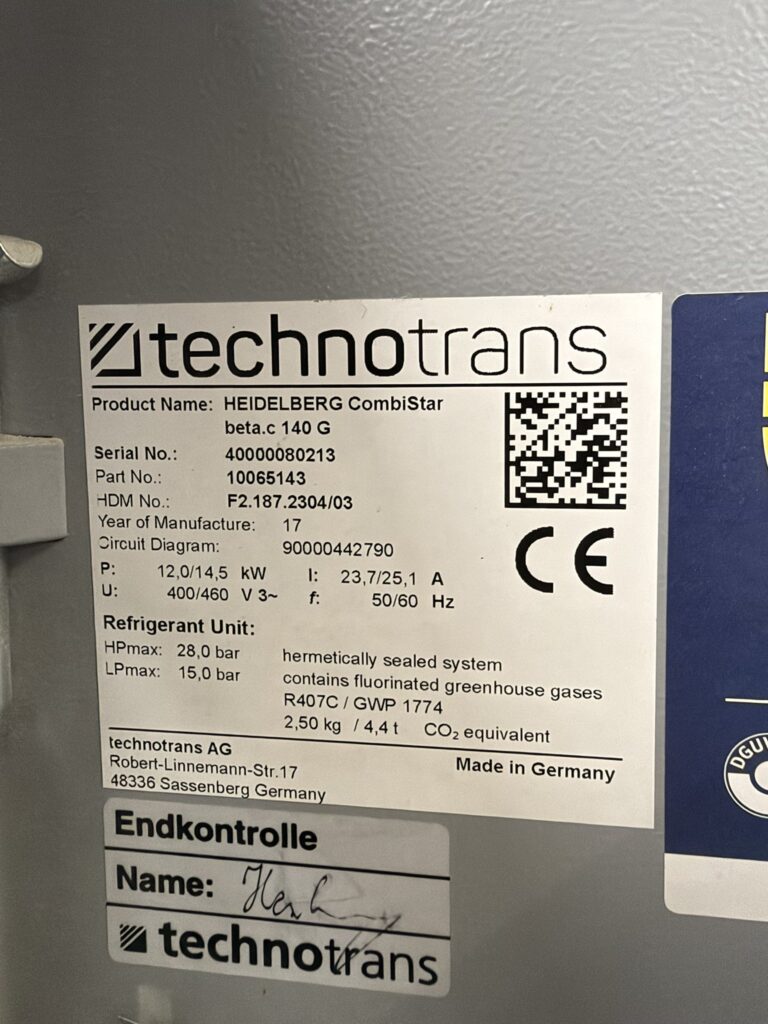
Many controllers can switch their display between unit systems, and a unit that was commissioned by a team from another country may still show psi and °F. Before you compare readings with your own gauges, check the unit setting in the controller menu. On nameplates, the design pressures are usually given as maximum allowable pressure (PS) in bar gauge for the high and low side; these values limit the settings of the safety devices and are the reference for any pressure test.
Practical tips
- Write the unit next to every value in reports and settings. A number without a unit is the most frequent source of confusion between teams.
- When you copy setpoints between controllers, check whether the controller works in bar or psi, and in gauge or absolute pressure.
- Round only at the end. Converting back and forth with rounded numbers can shift a value by a few per cent.
To turn a flow and a temperature difference into capacity, use the cooling capacity calculator. All our tools are listed on the refrigeration calculators page.
Frequently asked questions
How many kW is one ton of refrigeration?
One ton of refrigeration is 3.517 kW, or 12,000 BTU/h. A 100 TR chiller has about 352 kW of nominal cooling capacity.
Is psi on a gauge the same as psig?
Usually yes. Refrigeration gauges show gauge pressure, often written as psig or bar g. Absolute pressure is marked psia or bar a and is higher by about 14.7 psi or 1.013 bar.
Why does my converted temperature difference look wrong?
Probably because it was converted as a temperature, with the 32 °F offset. A difference of 5 K is 9 °F, not 41 °F. Use the temperature difference option for superheat, subcooling and water temperature differences.
Which gallon does gpm refer to?
In chiller documentation from American manufacturers it is the US gallon of 3.785 litres. The UK gallon of 4.546 litres appears only in older British documents. The converter offers both.
Documentation in units you do not use?
We read data sheets from all manufacturers and translate them into clear service reports in English, German or Polish.