Condensing units supply cold rooms, process coolers and the direct expansion coils of air handling units. We inspect, leak check, clean and repair them, with measurements that show whether the unit is still working within its design limits.
A condensing unit contains the compressor, the condenser with its fans and the controls, while the evaporator sits somewhere else: in a cold room, in a process cooler or in an air handling unit. That split makes faults harder to read. A rising cold room temperature can come from the condensing unit, from the evaporator and its defrost, from a door left open or from a leak in the pipework between them. Our service looks at the whole circuit, not only the box on the wall or on the roof.
Compressor and fan checks
The compressor is checked under real load. We measure suction and discharge pressures, convert them to saturation temperatures and calculate superheat at the compressor inlet. For most hermetic and semi-hermetic compressors the suction superheat should stay roughly between 8 and 20 K: lower values mean a risk of liquid reaching the compressor, higher values mean overheating of the motor and the oil.
- Running current on each phase compared with the rated current on the nameplate.
- Discharge line temperature, which on low temperature units should not stay above about 110 to 120 degrees C near the compressor.
- Crankcase heater function, essential on units installed outdoors that stand idle in winter.
- Oil level in the sight glass of semi-hermetic compressors and oil return on long pipe runs.
- Noise, vibration and condition of the anti-vibration mounts and pipe supports.
Condenser fans are checked for current, bearing noise, blade condition and the operation of the speed controller. A speed controller set too low in summer is a frequent cause of high pressure trips, while a fan running at full speed in winter causes too low condensing pressure and poor feed of the expansion valve.
Leak checks and refrigerant charge
Many condensing units in cold rooms still run on R404A or R507A, refrigerants with a very high GWP. That makes even a moderate charge subject to regular leak checks under Regulation (EU) 2024/573. The interval depends on the charge expressed in tonnes of CO2 equivalent.
| Refrigerant and charge | CO2 equivalent | Leak check interval |
|---|---|---|
| R404A, 8 kg (GWP 3922) | 31.4 t | Every 12 months (24 with a leak detection system) |
| R404A, 15 kg | 58.8 t | Every 6 months (12 with a leak detection system) |
| R449A, 15 kg (GWP 1397) | 21.0 t | Every 12 months (24 with a leak detection system) |
| R410A, 6 kg (GWP 2088) | 12.5 t | Every 12 months (24 with a leak detection system) |
Leak checks cover the condensing unit, the interconnecting pipework, the evaporator and all valves and joints. We use a calibrated electronic leak detector and record the result in the equipment records. The details of the procedure are on our F-gas leak checks page.
The charge itself is judged by subcooling at the condenser outlet and by the sight glass, never by pressures alone. Typical subcooling on an air-cooled condensing unit is 3 to 8 K. An undercharged unit loses capacity and overheats the compressor, an overcharged one condenses at too high a pressure and uses more energy.
Older R404A units should also be planned for the future: the regulation limits the use of virgin high-GWP refrigerants for servicing larger refrigeration equipment. We can tell you whether a retrofit to a lower GWP refrigerant such as R448A, R449A or R452A is technically reasonable for your unit or whether replacement is the better option.
Condenser cleaning
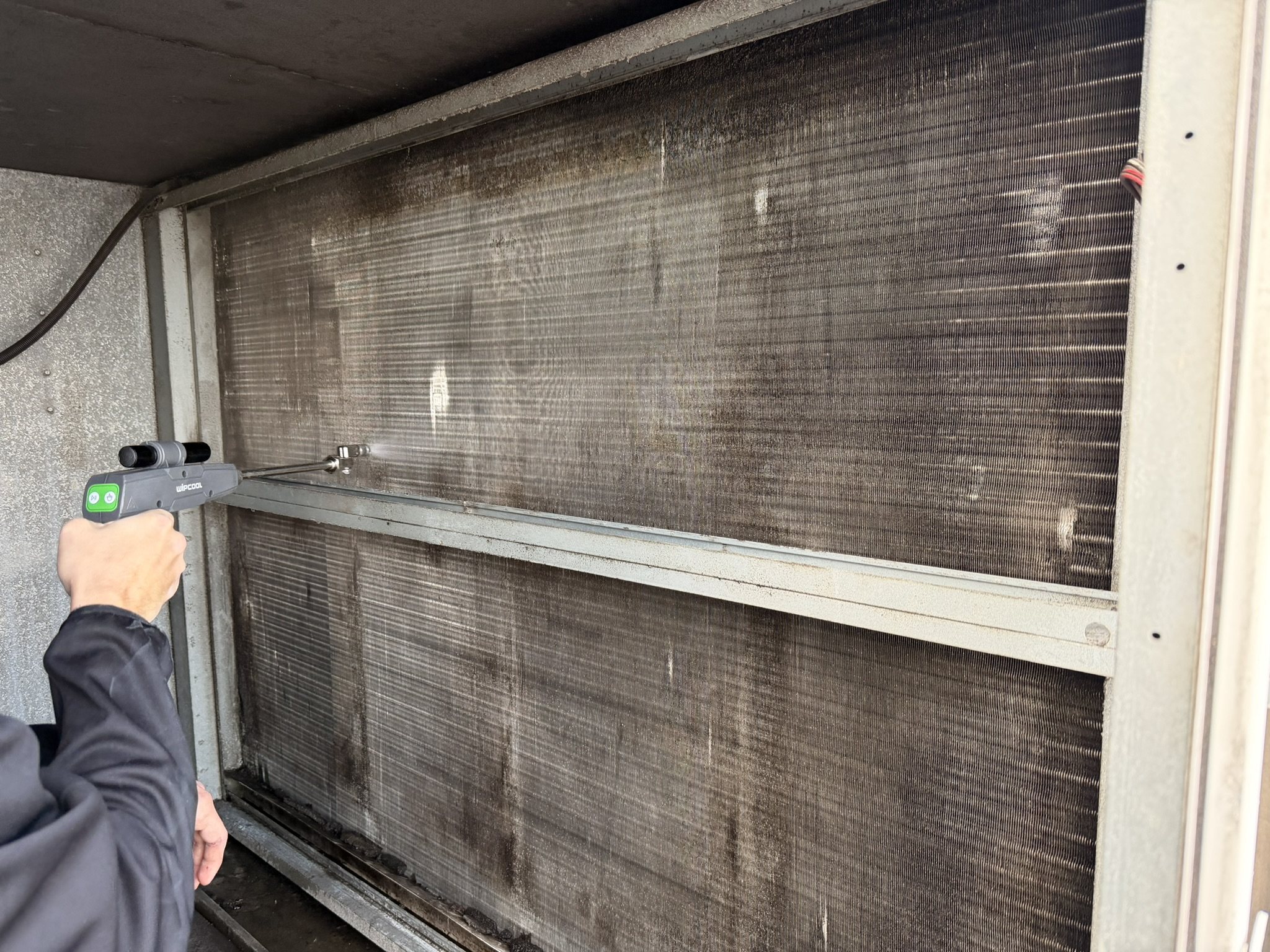
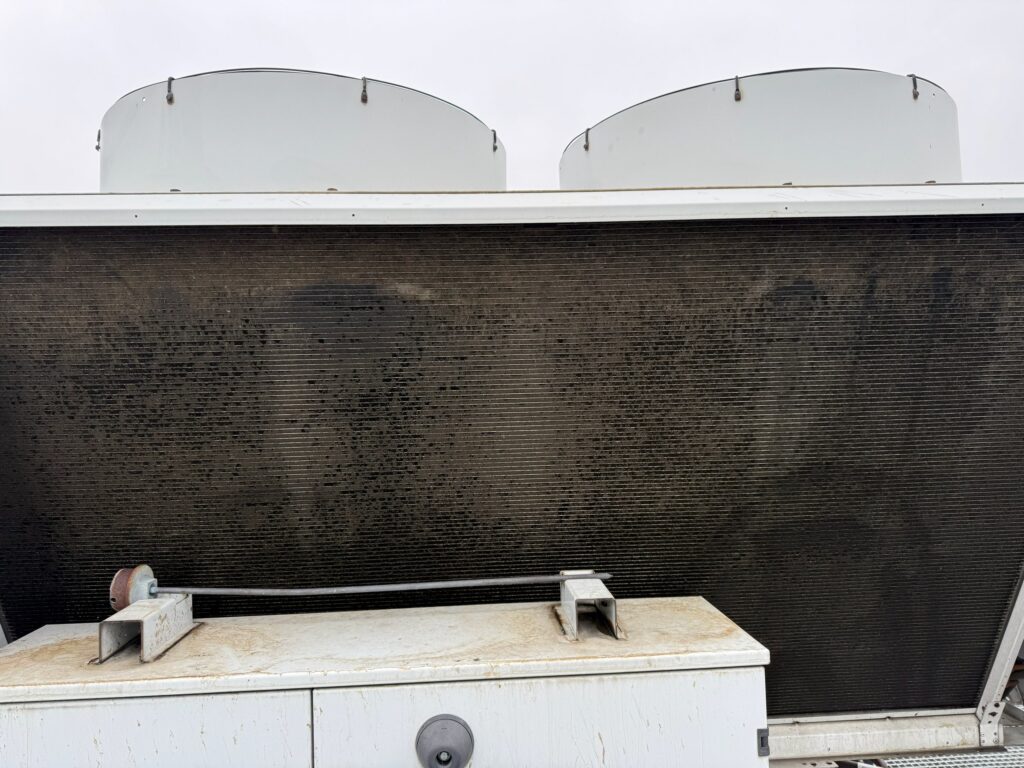
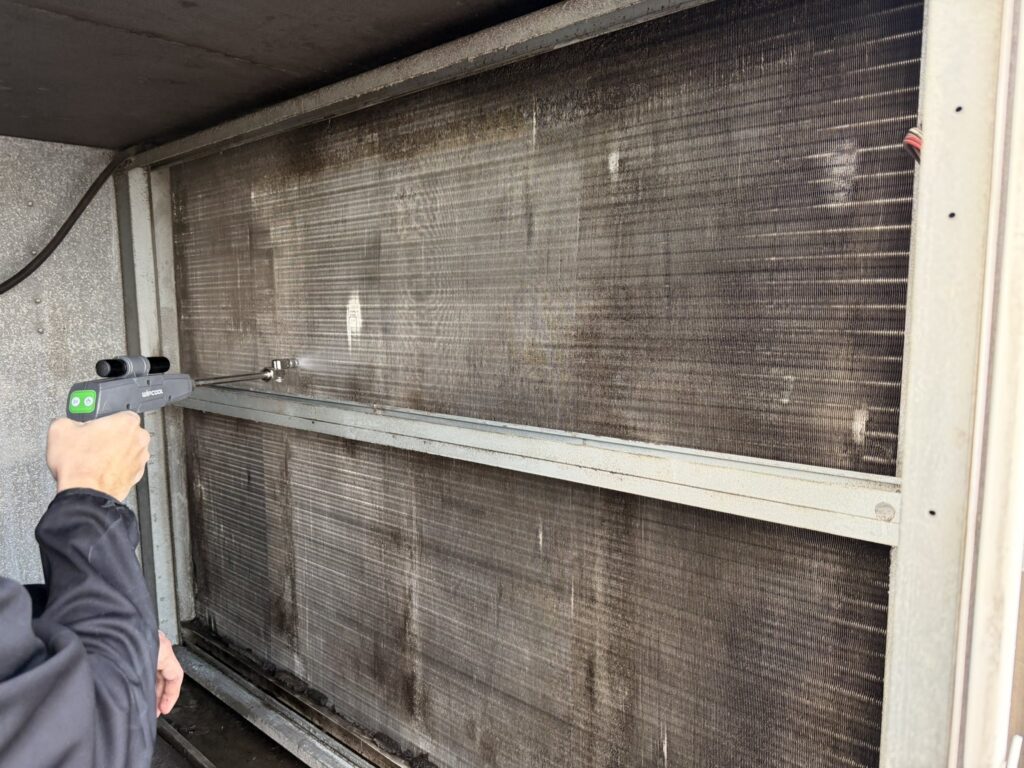
A condensing unit with a fouled coil uses more energy and trips in hot weather. Every degree of extra condensing temperature costs roughly 2 to 3 percent more energy. During service we measure the condensing temperature against the ambient air before and after cleaning, so you can see the effect. Coils are cleaned with a suitable cleaner and low pressure water, from the inside out where the design allows, without bending the fins. Larger jobs are described on the condenser cleaning page.
Controls and safety devices
The safety devices of a condensing unit protect the compressor and the people around it. We test them, not only look at them:
- High pressure switch: tripped by restricting the condenser airflow under supervision, cut-out value recorded.
- Low pressure switch: setting checked against the refrigerant and the application, so it protects without causing nuisance trips.
- Pump down cycle: solenoid valve closes, compressor stops on low pressure, no short cycling at standstill.
- Motor protection and phase monitoring relay: settings compared with the compressor data.
- Room or process controller: setpoint, differential, defrost settings and sensor accuracy against a reference thermometer.
Where a condensing unit serves the DX coil of an air handling unit we also check the capacity steps and the interlock with the supply fan. A compressor running without airflow over the coil will freeze the coil and return liquid. Air handling units themselves are covered on our air handling unit service page.
What you receive after the visit
After every visit you get an electronic report in English with the measured pressures, temperatures, superheat, subcooling, currents and the leak check result, plus photos of anything that needs attention. Findings are sorted into what needs action now, what should be planned and what is in order.
Frequently asked questions
How often should a condensing unit be serviced?
At least once a year, and before the summer for units with high condenser load. The legal leak check interval may be shorter, depending on the CO2 equivalent of the charge.
Do you service the evaporator in the cold room as well?
Yes. We check the evaporator, its fans, defrost heaters or hot gas defrost, drain line heating and the expansion valve as part of the circuit. We do not service refrigerated display cabinets.
Our R404A unit leaks regularly. Should we replace it?
First the leak must be found and repaired properly. After that we compare the cost of a retrofit with replacement, taking into account the age of the compressor and the restrictions on high GWP refrigerants.
Can you work on units in Germany?
Yes. Our team works on condensing units in Germany and other EU countries. Diagnostics on site start from 3,000 PLN net, labour is 500 PLN net per hour and travel is 3.20 PLN net per km.
Condensing unit due for service?
Send us the refrigerant type, the charge and the application and we will plan the inspection and leak check.