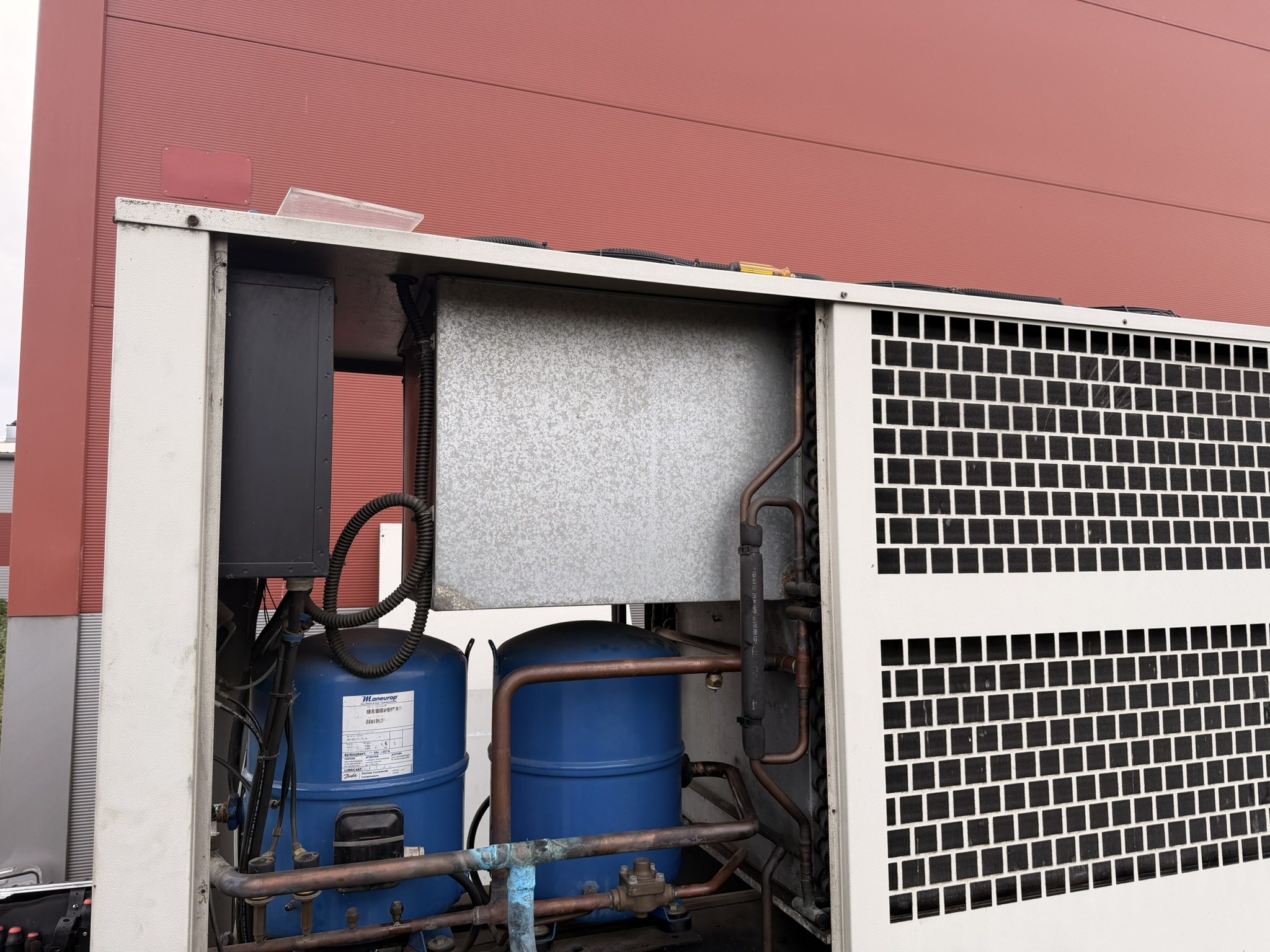

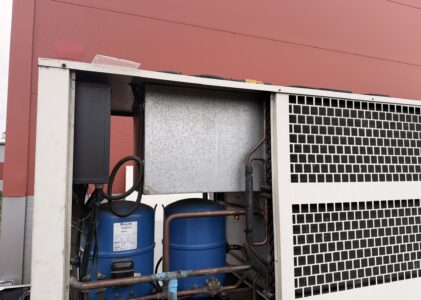
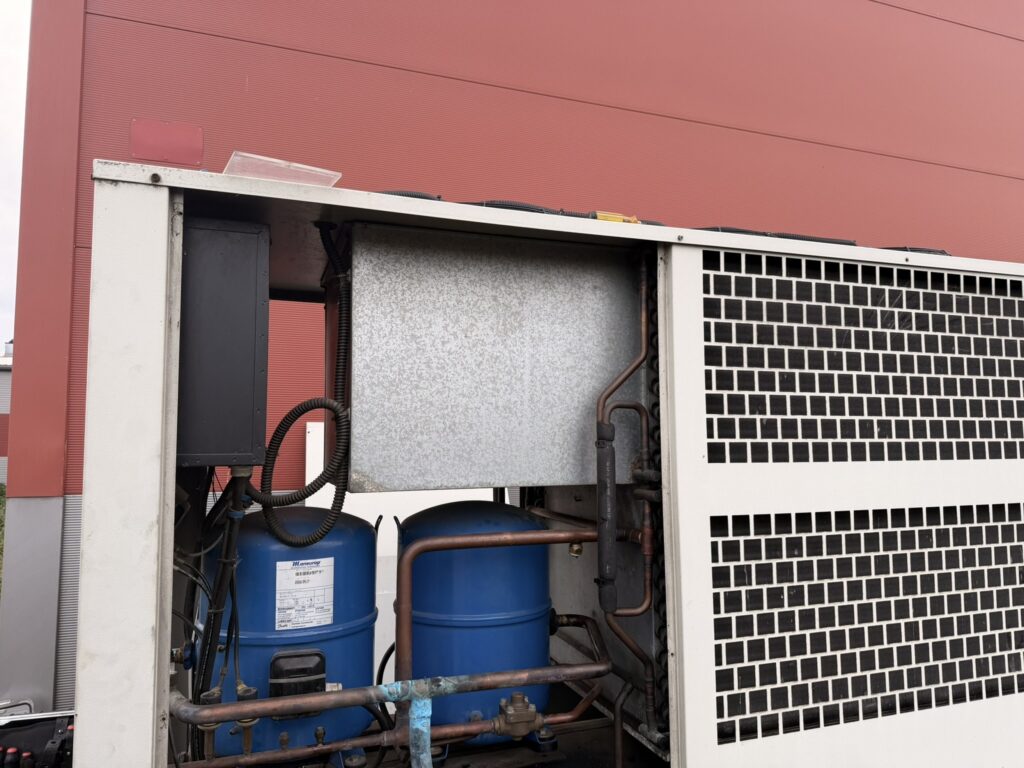
A chiller maintenance visit is worth paying for when it follows a written checklist and ends with a report you can compare with last year. Too many operators receive an invoice, a signature and the words “all fine”, and three months later the unit trips on high pressure. Below is the 24 point checklist we work through on every chiller maintenance, the readings that go into the report, what a maintenance contract covers and what you can check yourself between visits.
Why a checklist beats a visual inspection
A chiller has three systems that affect each other: the refrigerant circuit, the chilled water circuit and the electrical and control side. A visual inspection catches what is visible from outside, such as a dirty coil, oil stains or loose panels. The expensive failures start where you have to measure. A compressor running at 15 K superheat looks normal for weeks while it loses oil. A flow switch that still does not trip at 70 percent of design flow no longer protects the evaporator. That is why our maintenance consists of measured points with target values, not of a walk around the unit.
The 24 point chiller maintenance checklist
The list applies to air-cooled and water-cooled chillers with scroll or screw compressors. On dual circuit units every circuit is recorded separately.
| Area | Check | Target value or criterion |
|---|---|---|
| Refrigerant | Superheat at evaporator outlet | 5 to 8 K scroll, 6 to 10 K screw |
| Refrigerant | Subcooling at condenser outlet | 3 to 8 K, higher suggests overcharge |
| Refrigerant | Condensing temperature versus ambient | 12 to 18 K above ambient with a clean coil |
| Refrigerant | Sight glass and moisture indicator | no bubbles, indicator green |
| Refrigerant | Compressor oil level and colour | sight glass 1/4 to 3/4, oil clear |
| Refrigerant | Leak check under F-gas Regulation (EU) 2024/573 | every 12, 6 or 3 months depending on CO2 equivalent |
| Chilled water | Supply to return temperature difference | 4 to 6 K at design load |
| Chilled water | Pressure drop across evaporator and strainer | strainer below 0.3 bar, otherwise clean |
| Chilled water | Glycol concentration and pH | freeze point 5 K below lowest temperature, pH 7.5 to 9 |
| Chilled water | Flow switch trip point | trips at 60 to 70 % of design flow |
| Electrical | Compressor current per phase | phase imbalance below 5 % |
| Electrical | Contactors, terminals, insulation resistance | terminals torqued, insulation above 1 MΩ |
| Controls | Alarm log, start frequency | under 6 starts per hour per compressor |
The remaining points cover condenser fans (bearing noise, speed controller), the expansion valve (stroke, bulb fixing), the crankcase heater, evaporator insulation, the chilled water pump, the expansion vessel and the safety valves. Every point gets a reading or a dated “OK” in the report.
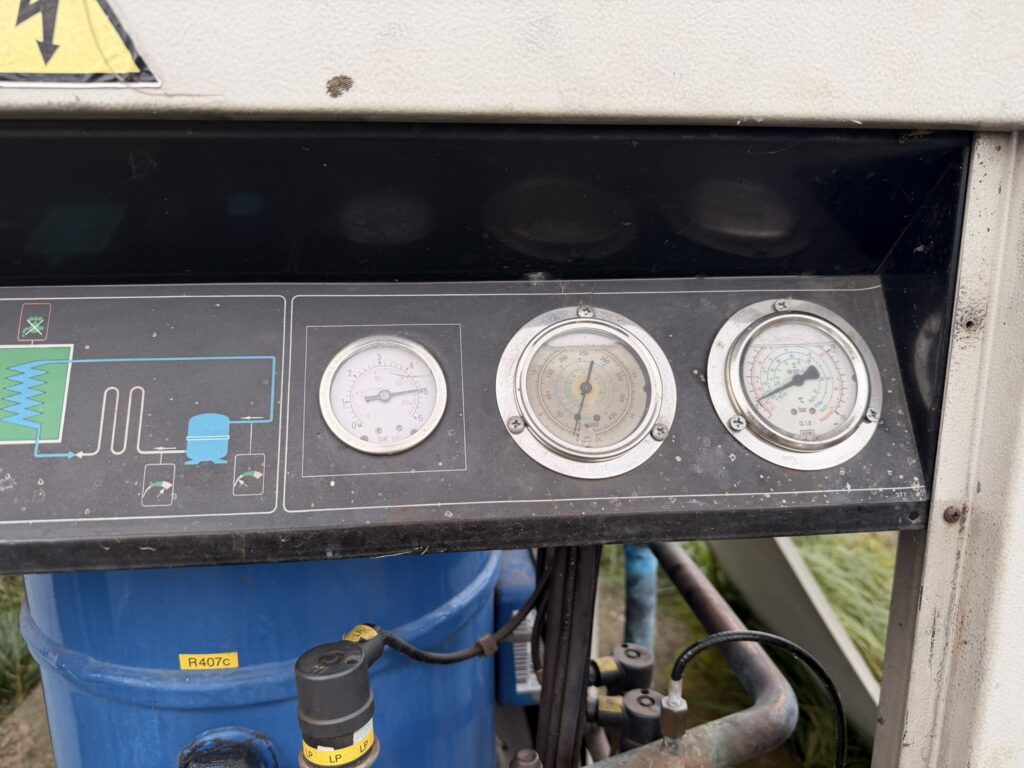
Readings we record in every report
The maintenance report is the basis for the next decision: repair, upgrade or replacement. We record the same values every time so that you can see trends. If condensing temperature rises year after year at the same ambient, the coil fouls faster than it is cleaned. If subcooling drops, the circuit is losing refrigerant even before the leak check finds the spot. If compressor current rises at the same load, the mechanics are wearing.
Every report contains: ambient temperature and time of measurement, chilled water supply and return, suction and discharge pressure per circuit, superheat and subcooling, current per phase, glycol concentration, strainer pressure drop, alarm log of the last 30 days, running hours and start counter, plus photos of the nameplate, the coil and the control panel.
Maintenance before winter and before summer
A chiller that runs all year needs two different visits. Before summer the focus is the condenser and the fans, because the unit reaches its limit at 35 °C ambient. Before winter we check antifreeze, the crankcase heater, fan speed control for low condensing pressure and trace heating on the pipework. What goes wrong in winter operation is covered in how to prepare a chiller for winter. For units that run only in season, one visit before start-up plus a mid-season coil check is enough.
What a maintenance contract includes, and what it does not
Our maintenance contracts have fixed dates, a fixed checklist and a fixed report. The contract covers the visits, the F-gas leak check, the logbook entry and the documentation of all readings. Spare parts and refrigerant are charged as used. The contract does not include a standby fee or an emergency service with response time. We sell working hours with a report, not availability. Faults between visits are handled as a repair order with its own quote, as described on the chilled water unit repair page.
For sites outside Poland we charge travel at 0.75 EUR per kilometre and labour at 115 EUR per hour. A first diagnosis with a full measurement report starts at 800 EUR net. The report is yours and can be handed to any other contractor.
What your maintenance team can check between visits
- Once a month look at the condenser coil for leaves, seed fluff and dust, and rinse it with a soft water jet from inside out.
- Once a week write down supply and return temperature and system pressure.
- After every alarm note the code, the time and the outdoor temperature instead of just resetting it.
- Clean the chilled water strainer once a quarter if the pressure drop exceeds 0.3 bar.
- Report oil traces under the compressor or at brazed joints at once, do not wipe them off.
The meaning of each code is in our list of chiller alarm codes, and the legal leak check interval comes out of the chiller inspection calculator.
Frequently asked questions about chiller maintenance
How often should a chiller be serviced?
How long does a maintenance visit take?
Does maintenance replace the leak check?
What does a maintenance visit cost?
Do I need a maintenance contract?
Would you like a maintenance visit with a checklist and a report? Send the manufacturer, model, site and the last report if you have one through the contact form or to info@chillerserwis.com. You will receive a quote with the scope and a proposed date.