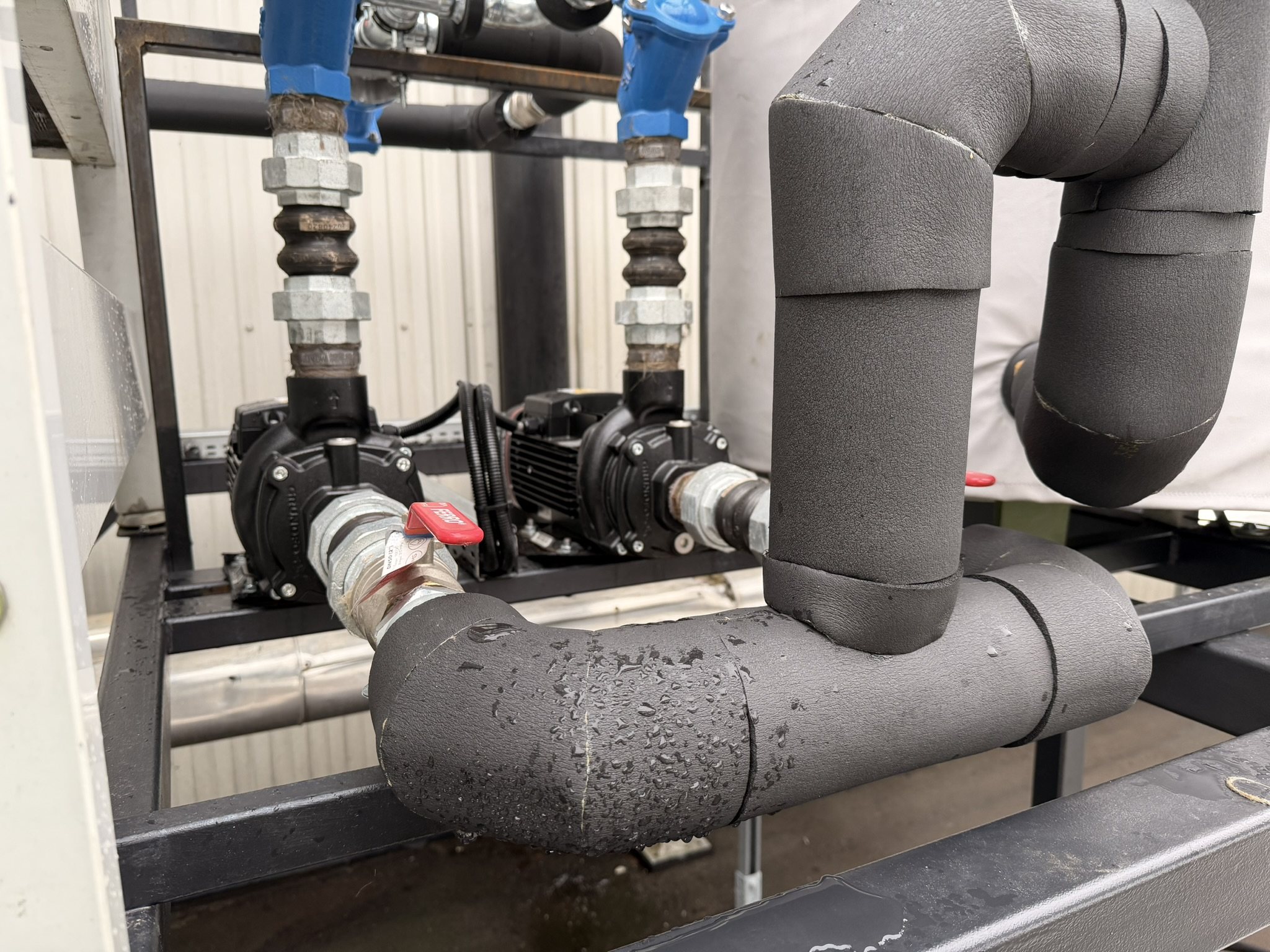
We service industrial and commercial refrigeration equipment, from small process coolers next to a single machine to large chilled water plants supplying a whole factory. Every job starts with measurements and ends with a written report in English.
A plant rarely has only one kind of cooling equipment. Next to the main chiller there are process coolers for injection moulding or laser machines, cooling and dampening systems on printing presses, condensing units for cold rooms, refrigerated compressed air dryers and dry coolers on the roof. Different suppliers installed them at different times. For a maintenance team it is easier to have one independent service partner who understands all of them and documents them in the same way.
Equipment we service
| Equipment | Typical application | Key points of the service |
|---|---|---|
| Air-cooled and water-cooled chillers | Process cooling, building air conditioning | Refrigerant circuit, compressors, heat exchangers, controls |
| Compact process coolers | Plastics, lasers, machine tools, laboratories | Water tank, pump, filter, temperature stability |
| Printing press cooling and dampening units | Offset printing | Dampening solution temperature, alcohol dosing, filtration |
| Condensing units | Cold rooms, DX coils in air handling units | Compressor, condenser, safety devices, leak checks |
| Refrigerated air dryers | Compressed air treatment | Pressure dew point, condensate drains |
| Dry coolers and remote condensers | Heat rejection, free cooling | Coil condition, fans, glycol |
| Industrial heat pumps | Process heat, heat recovery | Refrigerant circuit, defrost, controls |
The printing industry is a special area for us, with its own page on cooling in printing plants.
Diagnostics with measurements
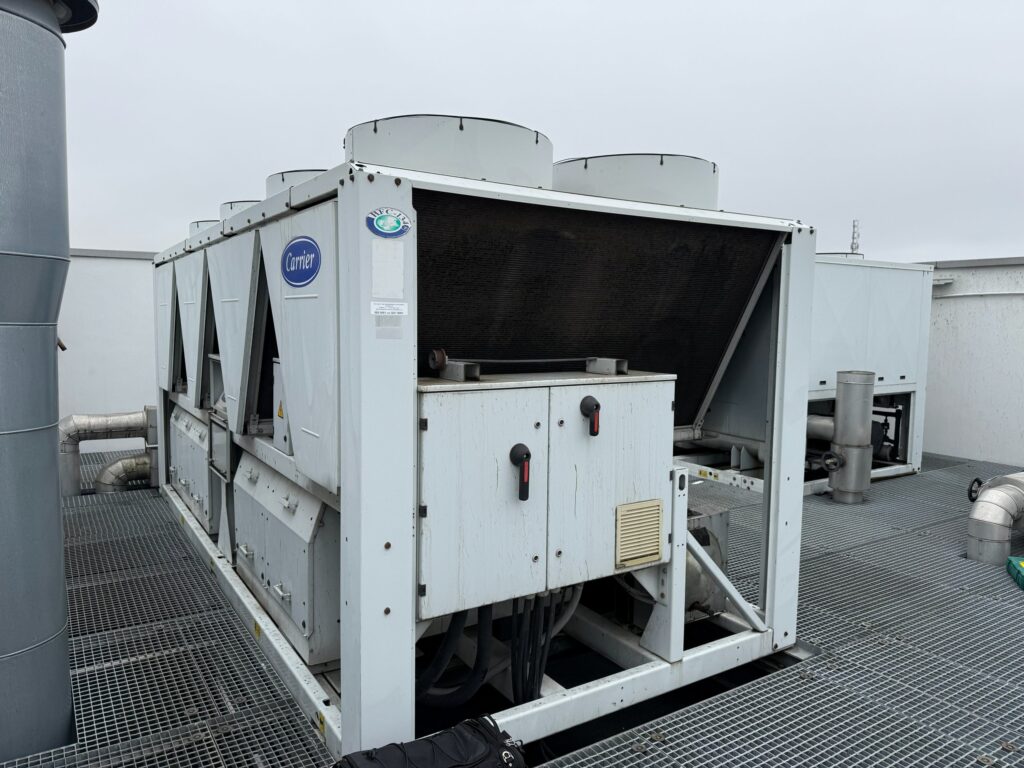
The basic measurements are the same on a 5 kW process cooler and on a 1 MW chiller: evaporating and condensing pressures converted to saturation temperatures, superheat, subcooling, compressor currents, fluid temperatures and the approach temperatures of the heat exchangers. What differs is the interpretation. A small process cooler with a capillary tube has no adjustable superheat and is very sensitive to the charge, while a screw chiller with an electronic expansion valve tells us a lot through its controller history.
We use digital manifolds, calibrated temperature probes, clamp meters, insulation testers and electronic leak detectors. Readings are written into the report as numbers, not as “OK” ticks, so they can be compared at the next visit.
Repairs and modernisation
Repairs follow the diagnosis. On site we replace compressors, fans, expansion valves, filter driers, sensors, contactors and controllers, carry out brazing with a nitrogen purge, evacuation and charging by weight. Smaller units that are easier to repair under workshop conditions are taken to our workshop in Wałsnów, tested after the repair and returned.
Modernisation makes sense when the core of the unit is sound but individual parts are outdated. Typical examples:
- Replacement of an old controller with a new one, with better alarm logging and remote access.
- Electronic expansion valves instead of thermostatic valves, for stable superheat at part load.
- EC fans or speed controlled fans on the condenser, to reduce energy use and noise.
- Additional filtration or a buffer tank on the water side to stop short cycling and fouling.
Every modernisation proposal comes with the expected effect and its cost, so you can compare it with replacing the unit.
Planned inspections
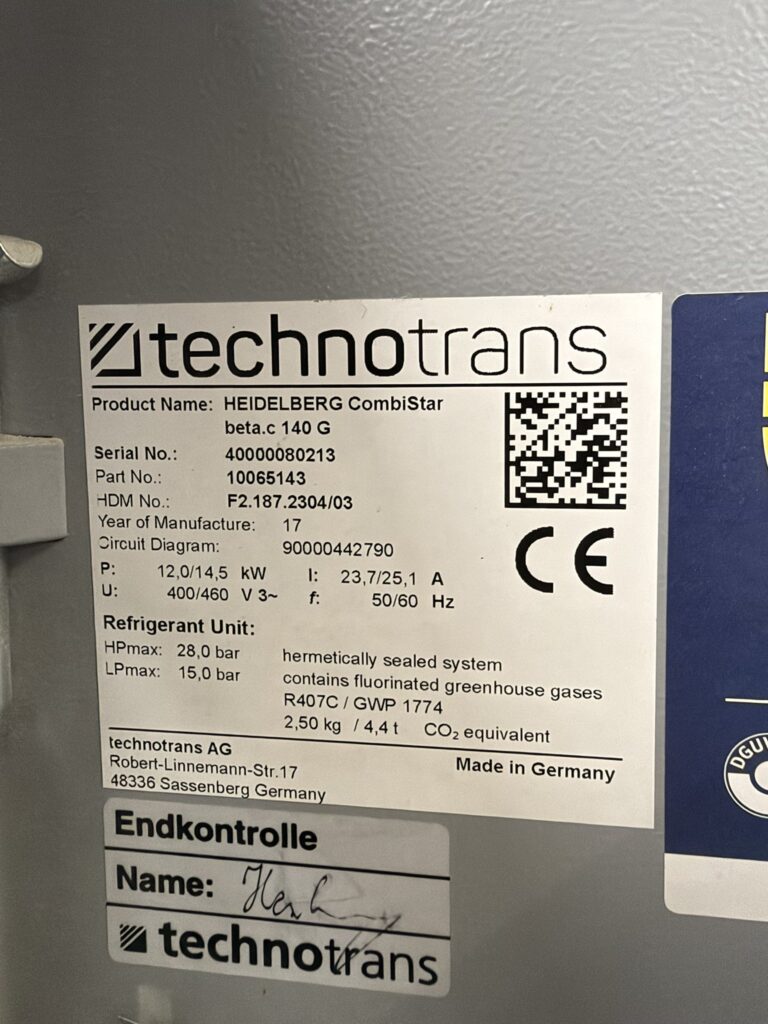
For plants with several units we prepare an inspection plan. It combines the legal leak checks, which depend on the CO2 equivalent of each charge, with technical inspections timed to the load: condensers and air-cooled units before the summer, dry coolers and glycol systems before the winter, process coolers during planned production stops. Combining visits saves travel costs and production time. The scope of a single inspection is described on the technical inspections page.
A typical annual plan for a medium-sized plant looks like this:
- Spring: inspection of air-cooled chillers and condensing units, condenser cleaning, leak checks.
- Summer: short check of critical process cooling during the peak load.
- Autumn: glycol tests, dry cooler inspection, frost protection checks.
- During production stops: work that needs a shutdown, such as heat exchanger cleaning or compressor overhauls.
Written reports in English
Each visit ends with an electronic report that the customer signs on site. It contains the equipment data, the measurements, photos, the work carried out, refrigerant quantities recovered or charged and a list of recommendations with priorities. Reports are written in English, which makes them easy to share with group headquarters, insurers or auditors. Communication by e-mail is possible in English, German or Polish.
Frequently asked questions
Do you take over equipment from other service companies?
Yes. We are independent and service all brands after the warranty has ended. At the first visit we document the current condition, so there is a clear starting point.
Can one contract cover different types of equipment?
Yes. We can plan inspections for chillers, condensing units, dryers and dry coolers together, with one schedule and one type of report.
What do you not service?
Split and VRF air conditioning, fan coil units, cooling towers and refrigerated display cabinets are outside our scope. We also do not offer a 24/7 standby service.
How are visits outside Poland priced?
Diagnostics on site start from 3,000 PLN net, labour is 500 PLN net per hour and travel is 3.20 PLN net per km. Planned visits are quoted in advance.
What do you need from us before the first visit?
A list of the units with make, model, serial number, refrigerant and charge, plus any known faults or alarm history. Photos of the nameplates are enough to start. With this information we can prepare the right parts, estimate the time on site and give you a fixed price for the first inspection.
One service partner for all your cooling equipment
Send us a list of your units and we will propose an inspection plan with fixed prices.