
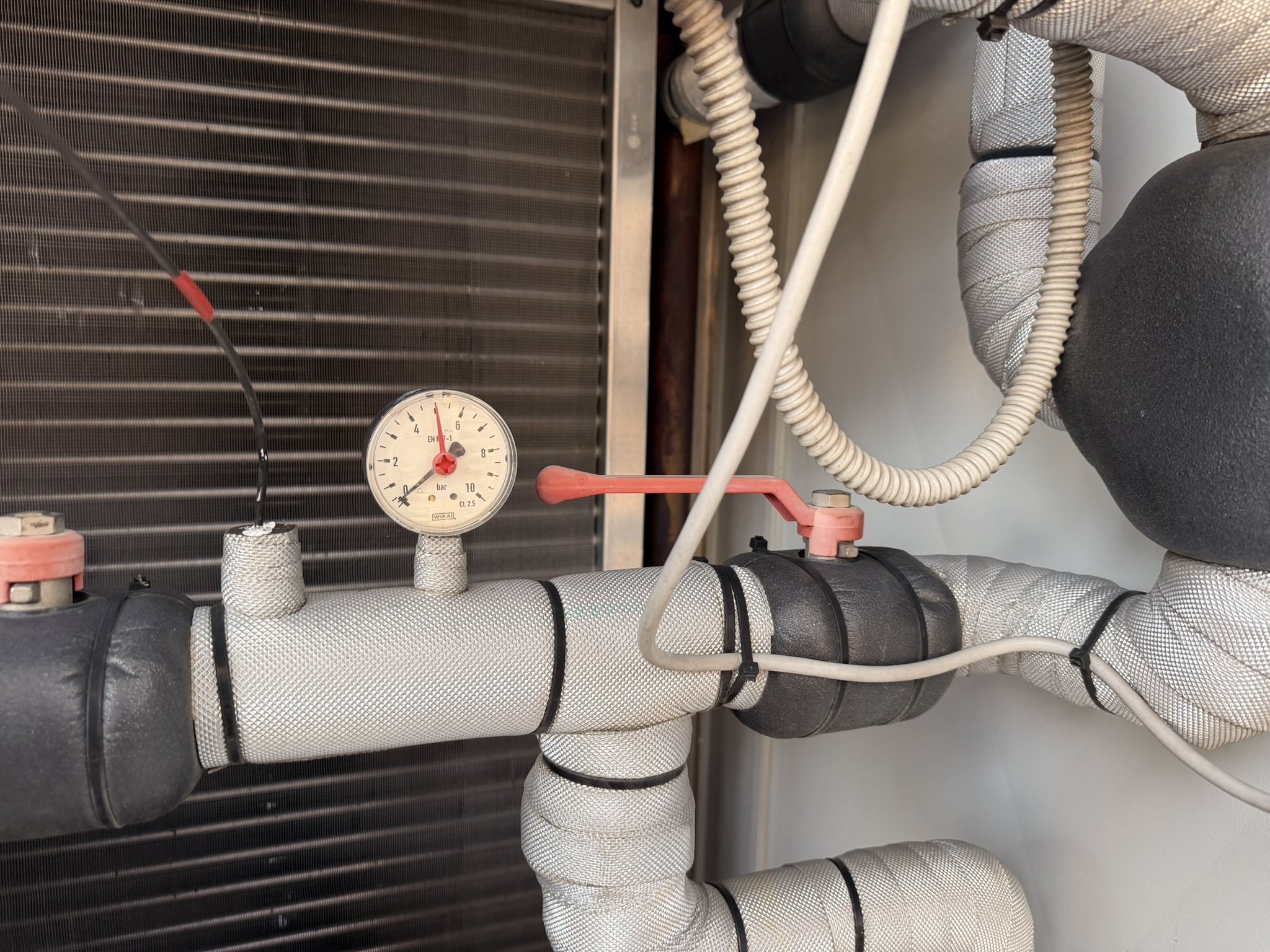
A dry cooler rejects heat from a water or glycol circuit directly to outdoor air through a finned coil and fans, without evaporating water and without a refrigerant circuit. It serves as the heat sink for water-cooled chillers, as a free cooling unit and as a direct cooler for processes that tolerate warmer fluid.
Dry coolers look simple, and that is why they are often neglected until the chiller behind them starts tripping on high pressure. This guide explains how they work, how free cooling saves energy and what we check during service.
How a dry cooler works
Warm fluid from the chiller condenser or from the process enters the coil, flows through copper tubes with aluminium fins, and returns cooler. Fans draw outdoor air across the fins. Because heat transfer relies only on the temperature difference between fluid and air, the outlet temperature of a dry cooler can never be lower than the ambient temperature. In practice it is usually 4 to 8 K above ambient at design conditions. This difference is called the approach.
Since the fluid usually stays outdoors all year, dry cooler circuits are filled with a water and glycol mixture. The coil is the part most exposed to frost damage when the glycol concentration drops.
Coil and fan design
Arrangement
Dry coolers are built in horizontal arrangement, with the coil lying flat and fans blowing upwards, or in vertical arrangement with the coil standing upright. Large units use a V-shaped coil arrangement to place more heat exchange surface on a smaller footprint. The arrangement affects how the coil collects dirt: horizontal coils collect leaves, seeds and dust on the top surface, while V-coils clog mostly on the air inlet faces.
Fans and speed control
Older dry coolers have AC fans switched on and off in steps or controlled by phase cutting regulators. Newer units use EC fans with integrated electronics and a 0 to 10 V or Modbus signal, which allow smooth speed control and lower power consumption. Because fan power rises roughly with the cube of speed, running all fans at reduced speed is much more efficient than running half of the fans at full speed.
Fin spacing
Fin spacing of about 2 to 3 mm is typical. Closer spacing gives more surface but clogs faster in dusty environments such as foundries, sawmills, plastics processing and near agricultural fields.
Free cooling
Free cooling uses cold outdoor air to cool the chilled water without running the chiller compressors, or with reduced compressor load. It is economical in processes and data rooms that need cooling all year round, and it works especially well in the climate of Central and Northern Europe.
In a typical arrangement, the return water first passes through a free cooling coil or a separate dry cooler. When the outdoor air is a few kelvin colder than the return water, the fluid is precooled and the chiller only covers the rest. When the outdoor temperature falls far enough below the supply setpoint, the dry cooler covers the whole load and the compressors stop.
| Operating mode | Condition (example: supply 15 °C, return 20 °C) | What runs |
|---|---|---|
| Mechanical cooling | Outdoor air above about 18 °C | Chiller compressors only |
| Partial free cooling | Outdoor air roughly between 7 and 18 °C | Dry cooler precools, compressors cover the remainder |
| Full free cooling | Outdoor air below about 7 °C, depending on load | Dry cooler and pumps only |
The exact switching points depend on the load, the size of the coil and the approach the system achieves. Higher chilled water temperatures extend the free cooling period considerably, which is one more reason not to run the chilled water colder than necessary. Typical problems with free cooling are faulty three-way valves, temperature sensors placed in the sun, and control settings that keep compressors running even though the outdoor air could do the work.
Frost protection
A frozen dry cooler coil usually means split tubes in many places and, in most cases, coil replacement. To prevent it:
- Choose a glycol concentration with a freezing point at least 5 K below the lowest expected ambient temperature at the site.
- Measure the concentration every year before winter and after every top-up.
- Never refill the circuit with plain water after a leak or repair.
- Check that the pumps keep circulating in winter even when there is no cooling demand, or that the control logic protects stagnant coils.
- Inspect drain points and vents, as these are where water collects in poorly drained sections.
Glycol testing and replacement is described in detail on our page about glycol testing and replacement.
Typical faults and what we check
Fouled coil
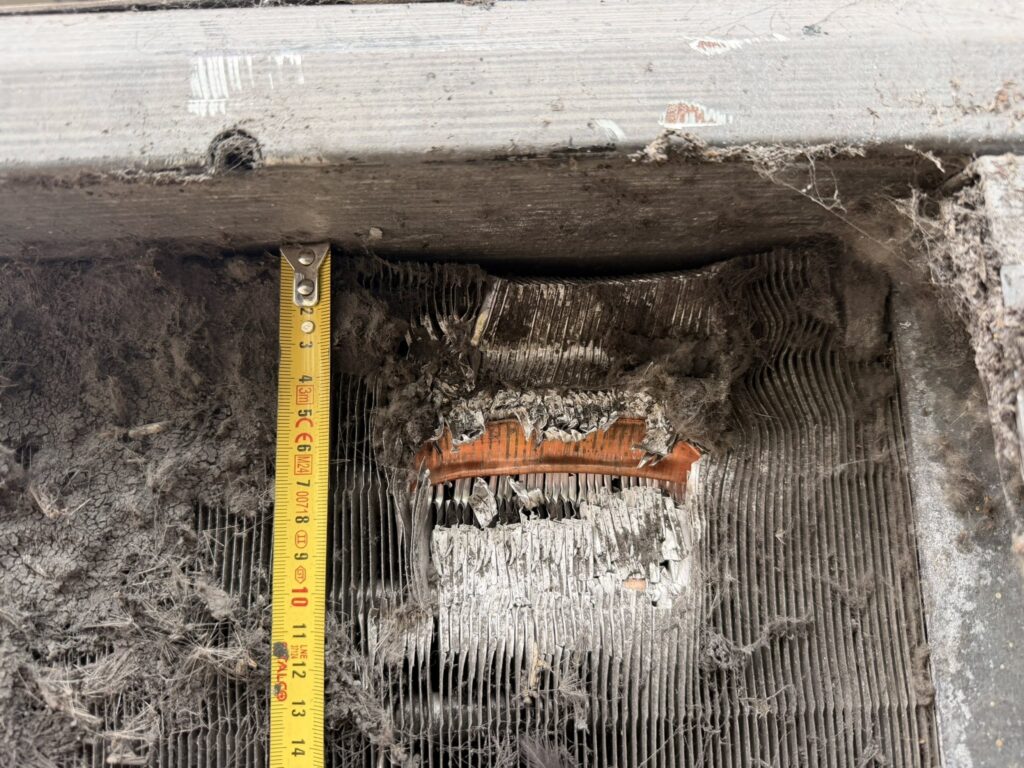
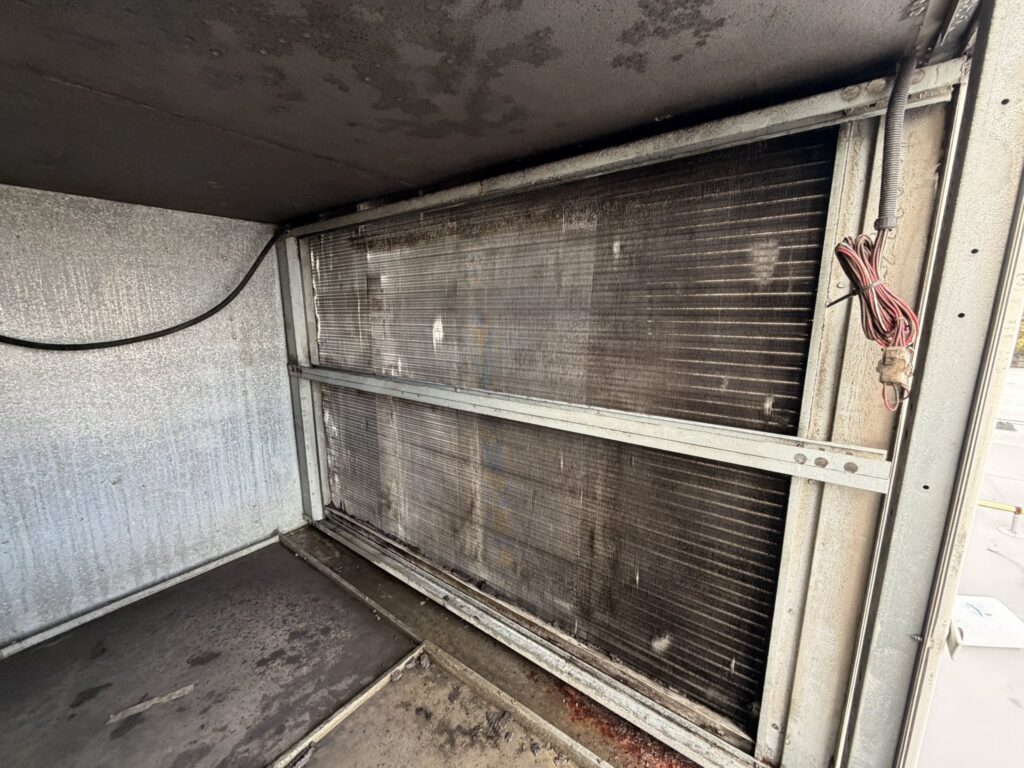
Dirt on the fins is the most common cause of poor dry cooler performance. Symptoms are a growing approach temperature and, for a chiller connected to the dry cooler, rising condensing pressure and high pressure alarms on warm days. Cleaning with low pressure water or foam from the air outlet side, against the normal air direction, restores performance. High pressure cleaning bends fins and should not be used.
Fan failures
Worn bearings, failed EC electronics, water ingress into motor terminal boxes and damaged cables are common. We measure fan currents, check the control signal and listen for bearing noise. One failed fan in a large unit does not always cause an alarm, but it reduces capacity and creates warm air recirculation.
Leaks and corrosion
Leaks appear at headers, return bends and where tubes rub against supports. Coastal and industrial atmospheres accelerate fin corrosion; coated fins or regular washing help.
Air in the circuit and low pressure
Dry coolers are often the highest point of the system. Automatic air vents that stick or leak cause pressure loss and noise. The static pressure on the dry cooler should be checked during every visit.
Service checklist
During a planned visit we record inlet and outlet fluid temperatures, ambient temperature and the resulting approach, fan currents and speeds, the condition of the coil, glycol concentration and pH, system pressure and the function of free cooling valves and sensors. Service of dry coolers, rooftop units and air handling units is summarised on our page about dry coolers, rooftops and AHUs.
Frequently asked questions
What is the difference between a dry cooler and a cooling tower?
A cooling tower evaporates part of the water to cool the rest and can reach temperatures close to the wet bulb temperature. A dry cooler only uses sensible heat transfer to air, so it uses no water and needs no water treatment for evaporation, but its outlet temperature always stays above the dry bulb temperature.
How often should a dry cooler be cleaned?
At least once a year before the warm season. Sites with poplar seeds, dust or oil mist often need two cleanings per year.
Can a dry cooler run with plain water?
Only if the circuit is reliably protected against frost, for example by draining in winter or by an indoor heat exchanger. In most installations a glycol mixture is the safer choice.
Why is free cooling not working even though it is cold outside?
Common causes are a stuck three-way valve, a faulty outdoor or fluid temperature sensor, wrong switching settings in the controller or a fouled coil that cannot reach the required approach.
What does adiabatic precooling add?
Adiabatic dry coolers wet pads or spray water into the incoming air on hot days, lowering the air temperature towards the wet bulb. This improves capacity in summer, but the water system then needs hygiene measures and regular maintenance.
Is your dry cooler losing capacity?
We measure the approach, clean the coil properly and check the glycol before the next winter.