A chiller is a refrigeration machine that cools water or a water and glycol mixture, which then carries heat away from processes, machines or buildings. This guide explains how a chiller works, which types exist and what decides its efficiency and service life.
Maintenance teams usually meet the chiller only when it stops. Knowing what happens inside the unit makes it much easier to read an alarm, to describe a fault to a service company and to decide which inspections are worth paying for.
How a chiller works: the refrigeration cycle
Every compression chiller uses the same closed circuit with four main components. The refrigerant changes state twice in each cycle, and this is what allows a relatively small machine to move a large amount of heat.
- Evaporator. Liquid refrigerant at low pressure boils and absorbs heat from the water or glycol. In a typical comfort system water enters at 12 °C and leaves at 7 °C, while the refrigerant evaporates at about 2 to 4 °C.
- Compressor. The compressor draws in the vapour and raises its pressure and temperature. It is the only component that consumes significant electrical energy in the circuit.
- Condenser. Hot, high pressure vapour gives off heat to outdoor air or to condenser water and turns back into liquid. In an air-cooled unit the condensing temperature is normally 10 to 15 K above the ambient air temperature.
- Expansion device. A thermostatic or electronic expansion valve reduces the pressure of the liquid and meters the flow into the evaporator so that the vapour leaving it is slightly superheated.
Two measured values tell a technician a lot about the state of the circuit. Superheat at the evaporator outlet, usually 4 to 8 K, shows whether the evaporator is properly fed. Subcooling at the condenser outlet, usually 3 to 6 K, shows whether the charge and the condenser are in order. A unit with high superheat and low subcooling is typically short of refrigerant; high subcooling with high condensing pressure points to overcharge or non-condensable gases.
Air-cooled and water-cooled chillers
The basic division of chillers follows the way the condenser rejects heat.
Air-cooled chillers
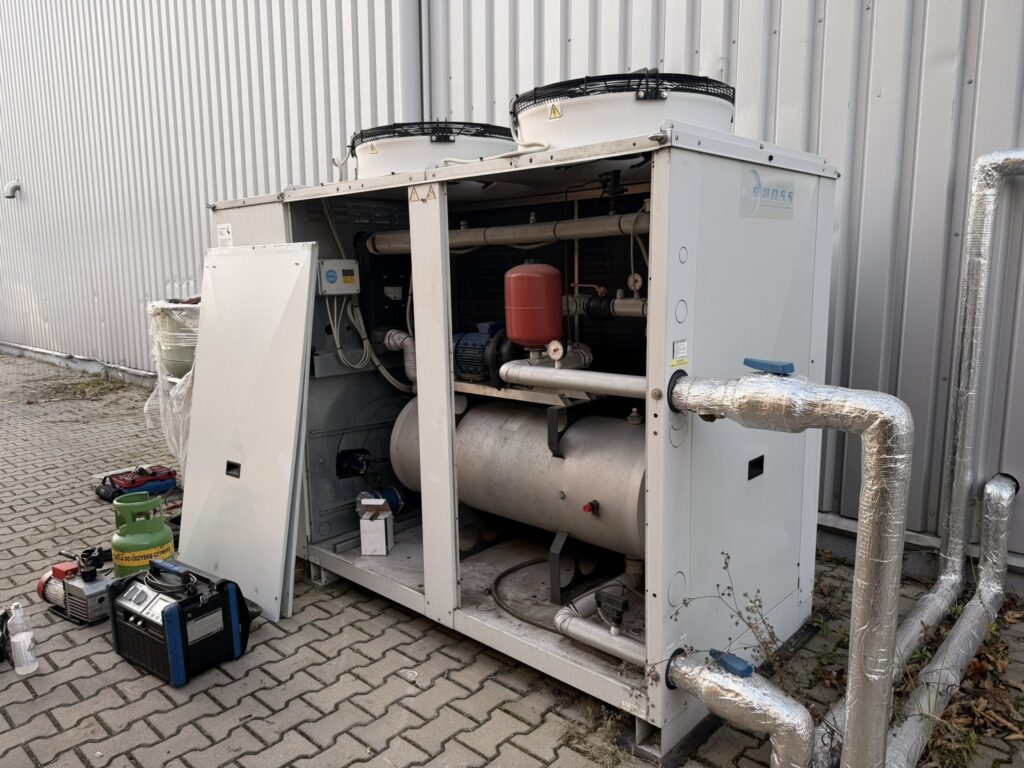
Air-cooled units have finned coil condensers with axial fans and are installed outdoors, on roofs or next to production halls. They need no cooling tower or condenser water circuit, which keeps installation simple. Their weak point is the condenser coil: dust, pollen, oil mist and leaves reduce the airflow, condensing pressure rises and the unit trips on high pressure on the hottest days. Regular condenser cleaning is the cheapest efficiency measure for this type.
Water-cooled chillers
Water-cooled units have a shell and tube or plate condenser connected to a cooling tower, a dry cooler or a river or well water circuit. They are usually installed indoors in plant rooms and achieve lower condensing temperatures, so their efficiency is higher. In exchange, the condenser water side needs attention: scale and biological fouling in the condenser raise the approach temperature and the power input.
Compressor types
The compressor defines the capacity range, the part load behaviour and the type of service the chiller will need.
| Compressor | Typical range in chillers | Capacity control | Service notes |
|---|---|---|---|
| Scroll | Small and medium units, often several compressors in tandem or trio | On and off staging, sometimes inverter driven | Hermetic, not repairable; replaced as a unit. Sensitive to liquid floodback and reversed rotation. |
| Piston (reciprocating) | Older and smaller units, process chillers | Cylinder unloading or staging | Semi-hermetic versions can be overhauled. Valve plates and oil condition need checking. |
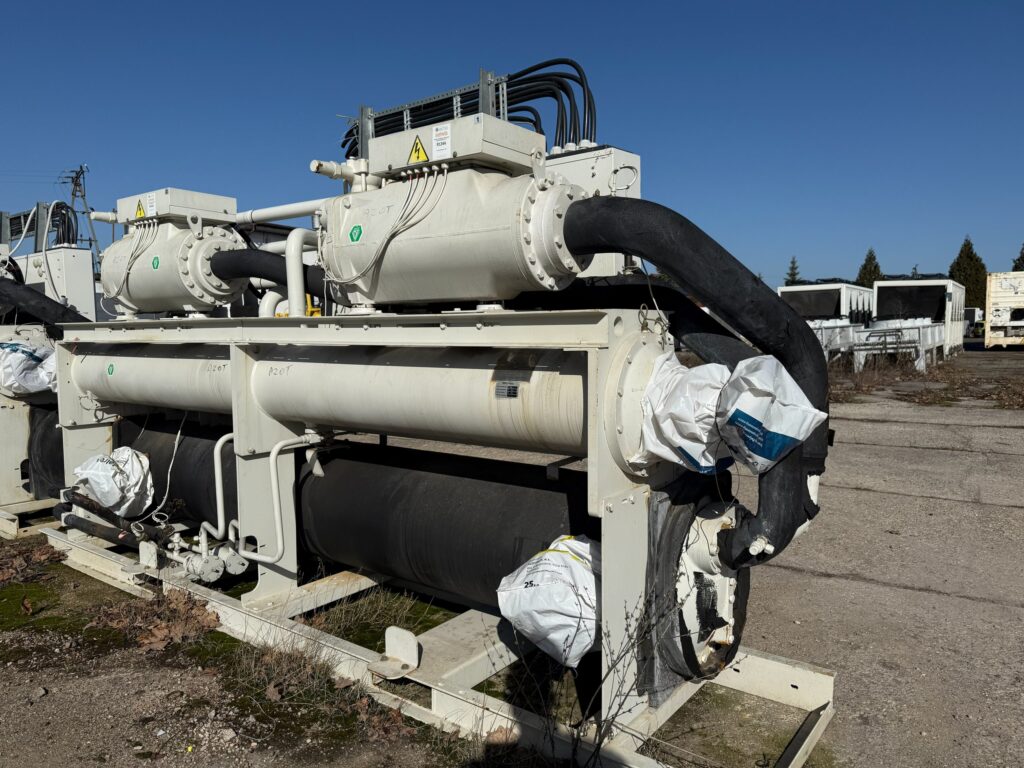
| Screw | Medium and large units | Slide valve or inverter, stepless | Oil separator, oil filter and bearings are key. Vibration and oil analysis help to plan overhauls. |
| Centrifugal | Large water-cooled plants | Inlet guide vanes, variable speed | High efficiency at full and part load; specialised service, sensitive to surge. |
Scroll compressors dominate units up to medium capacity because they are compact, quiet and reliable when the circuit is kept clean and dry. Screw compressors are chosen where long running hours and stepless control matter. A compressor failure is rarely the root cause of a breakdown: overheating, lack of oil return, liquid slugging or electrical problems usually come first, which is why a replacement should always include an analysis of the cause.
Efficiency: EER, SEER, ESEER and SEPR
Efficiency figures appear in every datasheet, but they describe different operating points.
- EER (Energy Efficiency Ratio) is cooling capacity divided by electrical power input at one rated condition, usually water 12/7 °C and outdoor air 35 °C for air-cooled units. An EER of 3.0 means 3 kW of cooling for each 1 kW of electricity.
- ESEER (European Seasonal EER) is an older Eurovent weighted average of four part load points: 3 % at 100 % load, 33 % at 75 %, 41 % at 50 % and 23 % at 25 %. It shows that a chiller spends most of its life at part load.
- SEER is the seasonal ratio calculated according to EN 14825 and used by the ecodesign rules for comfort chillers. It replaced ESEER in product information.
- SEPR (Seasonal Energy Performance Ratio) is the seasonal indicator for process chillers, which run at constant low water temperatures all year.
In practice the real efficiency of an existing unit depends less on the datasheet than on its condition. A fouled condenser, a wrong refrigerant charge, a chilled water setpoint lower than necessary or a pump running against a closed valve can easily cost more than the difference between two chiller models. Raising the chilled water temperature by 1 K typically improves efficiency by about 2 to 3 %, if the process or the air handling units allow it.
Refrigerants used in chillers
Older units often contain R407C or R134a, while many units built in the last decade use R410A. New designs move towards lower GWP refrigerants such as R32, R454B, R513A, R1234ze and propane (R290). The refrigerant matters for service in two ways: the GWP and charge determine the CO2 equivalent and thus the leak check interval under Regulation (EU) 2024/573, and some refrigerants are classified as mildly flammable (A2L) or flammable (A3), which changes the tools and procedures used. Details are on our page about F-gas leak checks.
What shortens the service life of a chiller
From the service perspective, the most frequent causes of serious damage are predictable:
- Insufficient water flow through the evaporator, leading to freeze-up and cracked plate or tube heat exchangers.
- Too little water volume in the system, causing frequent compressor starts and overheating.
- Dirty condensers and repeated high pressure trips that are reset without finding the cause.
- Small refrigerant leaks that are topped up for years instead of being repaired.
- Moisture in the circuit after poorly done repairs, which produces acids and damages compressor windings.
- Degraded glycol with exhausted inhibitors, causing corrosion and deposits on the water side.
Maintenance in practice
A sensible maintenance plan for a chiller combines a yearly or half-yearly inspection with measurements, the legally required leak checks and condenser cleaning before the warm season. During an inspection we record suction and discharge pressures, superheat, subcooling, compressor currents, water temperatures and pressure drops, and compare them with the previous visit. Trends are more valuable than a single reading. The scope of a typical visit is described on the chiller service page.
Frequently asked questions
What is the difference between a chiller and an air conditioner?
A chiller cools a liquid that is pumped to air handling units, fan coils or process machines. A split or VRF air conditioner cools room air directly with refrigerant. Chillers are used where cooling must be distributed over larger distances or delivered to processes.
How long does a chiller last?
With regular maintenance, units commonly run for 15 to 20 years or longer. Service life depends mostly on running hours, water quality, the condition of the condenser and how faults were handled in the past.
Which chilled water temperature is normal?
Comfort systems usually work at 7/12 °C or 10/15 °C. Process systems range from about 5 °C to above 20 °C, depending on the machine being cooled. Lower temperatures need glycol and cost more energy.
Why does my chiller trip on high pressure in summer?
The most common causes are a fouled condenser coil, failed condenser fans, overcharge or non-condensable gases in the circuit, and recirculation of warm air around the unit. A measurement of condensing pressure against ambient temperature usually narrows it down quickly.
Can an old chiller be converted to a new refrigerant?
Some units can be retrofitted to a lower GWP refrigerant, but compatibility of oil, seals, expansion valve and capacity must be checked first. Often a modernisation or replacement is the better long-term option, and we recommend deciding after a diagnosis.
Do you need help with a chiller?
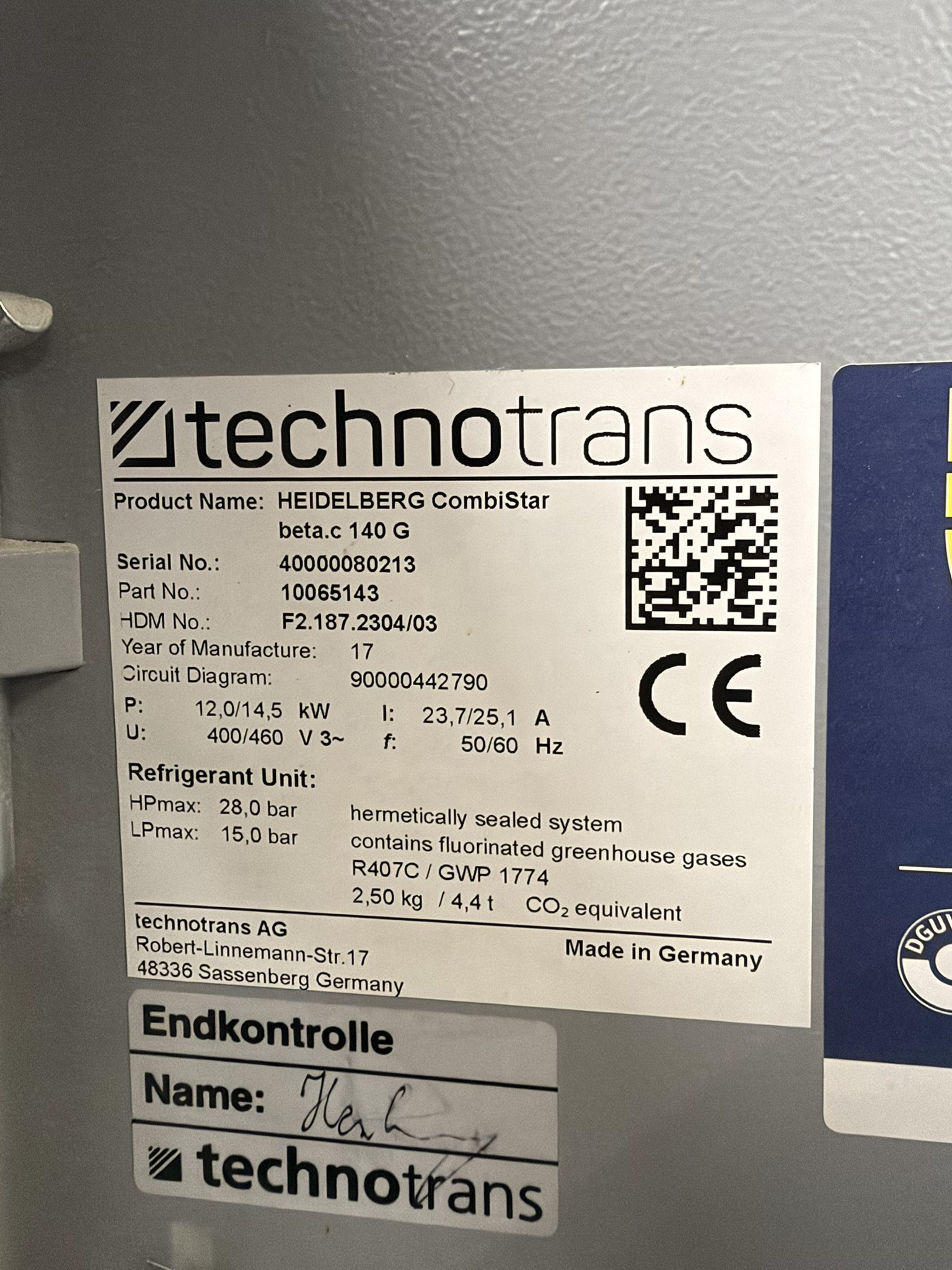
Send us the nameplate photo and the alarm text, and we will propose a diagnosis with measurements.