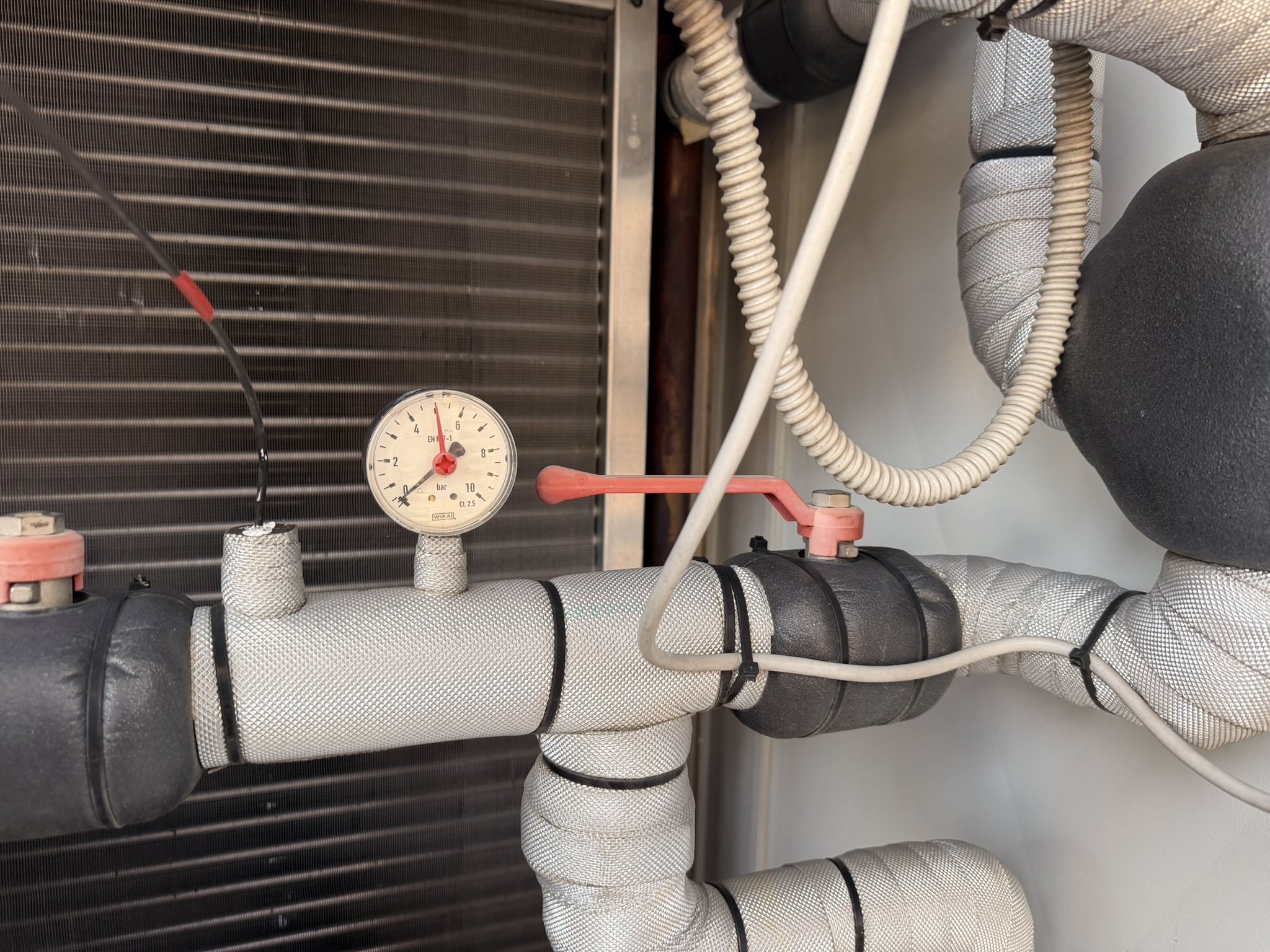
We repair air-cooled and water-cooled chillers only after a diagnosis with measurements, so the part we replace is the part that caused the fault. Compressors, leaks, expansion valves, fans and controls are repaired to a documented standard and checked again before we leave.
A chiller that fails once and is put back into service without a cause will usually fail again, often in a more expensive way. A compressor that burnt out because of liquid flood back will destroy its replacement within weeks if the expansion valve or the charge is not corrected. That is why our repairs always start from the readings taken during chiller service and diagnostics and end with a control measurement that proves the unit is working within its design limits.
Compressor replacement with cause analysis
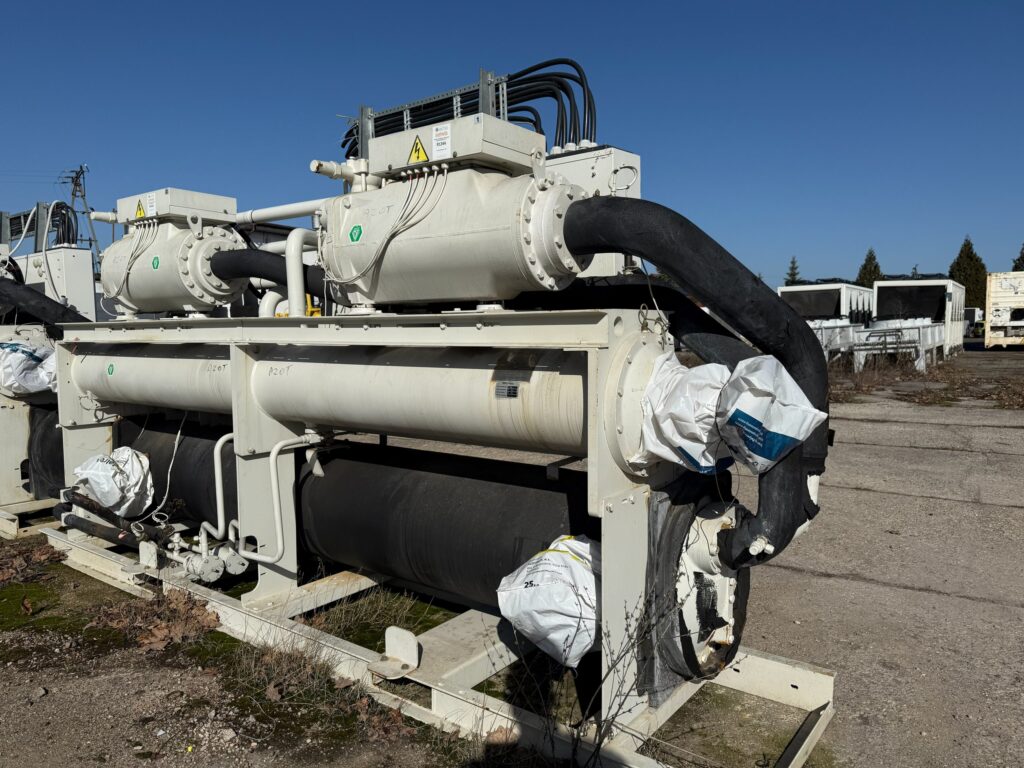
Compressor failure is the most costly repair on a chiller, so it deserves the most careful work. Before we order a scroll, screw or semi-hermetic piston compressor we establish why the old one failed.
What we check before ordering a compressor
- Insulation resistance of the windings to earth and between phases, to separate a burnt motor from a contactor or supply fault.
- An oil acid test. Acid in the oil after a burnout means a burnout filter drier on the suction side and, in serious cases, an oil change after the first hours of operation.
- Oil level and condition, signs of copper plating or metal particles.
- Superheat history and expansion valve condition, because flood back and too high superheat both kill compressors.
- Start counts and the control band. Short cycling, often caused by too small a water volume, leads to motor and contact wear.
- Supply voltage, phase balance and the setting of the motor protection.
On multi-compressor circuits we also check whether the oil equalisation works, because a tandem or trio set with unequal oil levels will lose another compressor sooner or later.
Leak repair, brazing, vacuum and charging
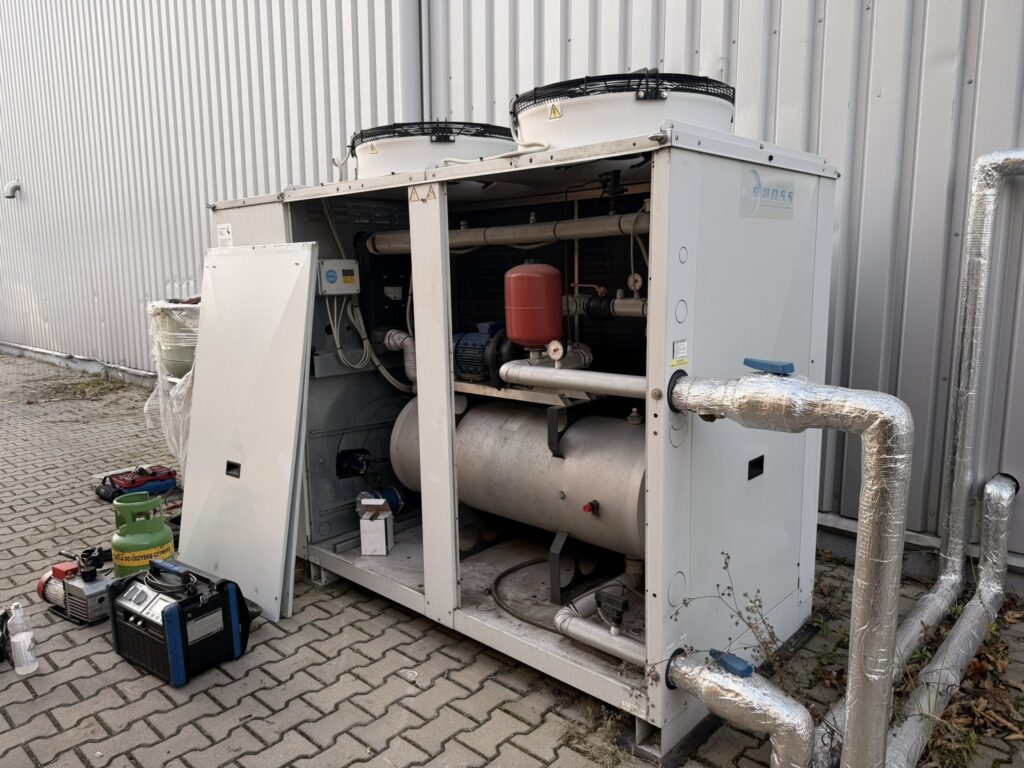
A refrigerant leak is not fixed by topping up. We locate the leak with an electronic detector and, where needed, with a nitrogen pressure test and bubble solution. Typical leak points are brazed joints exposed to vibration, Schrader valves, flare connections on pressure transducers, capillary tubes rubbing against each other and corroded condenser coil return bends.
The repair follows a fixed sequence:
- Recovery of the refrigerant into recovery cylinders, with the quantity weighed and recorded.
- Brazing with a nitrogen purge inside the pipe, so no copper oxide scale forms and later blocks strainers and expansion valves.
- A strength and tightness test with dry nitrogen, at a pressure that respects the maximum allowable pressure on the nameplate.
- Evacuation to below 500 microns (about 0.67 mbar) and a decay test. If the vacuum rises, there is still moisture or a leak.
- Charging by weight to the value on the nameplate, then a check of superheat and subcooling under load.
Every recovered and charged quantity goes into the report and the equipment records, as required by the F-gas regulation. A follow-up leak check within one month of the repair is part of the job.
Expansion valves, filter driers, sensors and contactors
Many chiller faults that look serious are caused by small components. The table shows the most frequent ones and how we confirm them.
| Component | Typical symptom | How we confirm it |
|---|---|---|
| Thermostatic or electronic expansion valve | Low pressure trips, hunting superheat, low capacity | Superheat at several loads, valve opening on the controller, coil and driver check |
| Filter drier | Bubbles in the sight glass despite correct charge, low suction pressure | Temperature drop across the drier above 1 to 2 K |
| Temperature or pressure sensor | Wrong readings, false alarms, unstable control | Comparison with a calibrated reference thermometer or gauge |
| Contactor or soft starter | Compressor hum without start, phase loss alarms | Voltage on all phases at the motor terminals, contact resistance, visual check of burnt contacts |
| Condenser fan motor or EC drive | High pressure trips at high ambient | Fan current, speed control signal, bearing noise |
We replace parts with original or equivalent components of the same specification. When an original part has long delivery times we tell you the options, including a compatible alternative, before we order.
Controls and electrical faults
Modern chillers depend on their controller as much as on their compressors. We read the alarm history, check the parameters against the original settings and test the safety chain: high pressure switch, flow switch, frost protection and motor protection. A flow switch bridged years ago “temporarily” is a common finding, and it is the reason why some evaporators freeze and crack.
Control measurements and report after the repair
A repair is finished only when the readings confirm it. After start-up we record evaporating and condensing temperatures, superheat, subcooling, compressor currents, supply and return water temperatures and, where possible, the approach temperatures of both heat exchangers. These values go into the electronic report in English together with photos of the replaced parts, and the customer signs it on site.
If the cause of the fault lies outside the chiller, for example a fouled condenser, low water flow or degraded glycol, the report says so and recommends the next step, such as condenser cleaning or a glycol test. Small units can also be repaired in our workshop in Wałsnów.
Frequently asked questions
Can you repair a chiller without a diagnostic visit first?
For simple, clearly identified faults, such as a broken sensor with a known part number, yes. For compressor failures, leaks and recurring trips we always diagnose first, because a repair without a cause usually has to be repeated.
Is it worth repairing an old chiller?
It depends on the condition of the heat exchangers, the refrigerant and parts availability. After the diagnosis we give you the repair cost and, if it makes sense, a comparison with modernisation or replacement.
How long does a compressor replacement take?
The work on site usually takes one to two days. The overall time depends mainly on the delivery time of the compressor, which we confirm before ordering.
Do you use the same refrigerant after a repair?
Normally yes, charged by weight to the nameplate value. If the refrigerant is restricted or hard to obtain we discuss the options with you before the repair.
What does a repair in Germany cost?
Diagnostics on site start from 3,000 PLN net, labour is 500 PLN net per hour and travel is 3.20 PLN net per km. Parts are quoted separately after the diagnosis.
Chiller stopped or tripping?
Send us the alarm text and the nameplate data and we will plan the diagnosis and the repair.