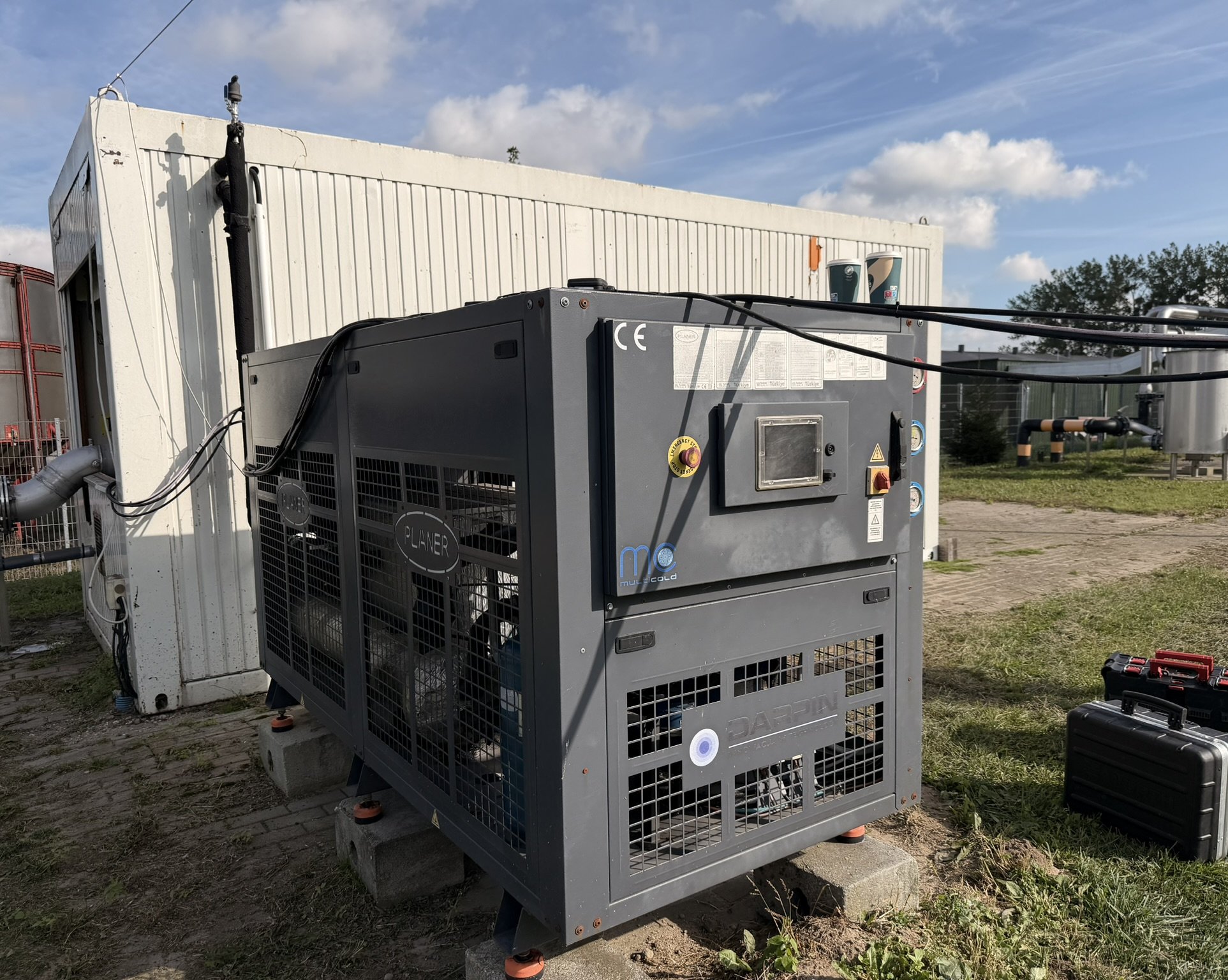

The compressors stop, the display shows “Flow Alarm”, “Evaporator Water Flow Lost” or a short code such as FL, P-14 or 10091, and the process or the building is suddenly without cooling. A chiller flow switch alarm is one of the most common reasons for an unplanned shutdown, and in most cases the chiller itself is fine. The problem sits in the chilled water circuit: a pump, a strainer, a valve or air in the pipes. This article explains why the flow switch trips, how to estimate the flow your evaporator needs, what your maintenance team can safely check and when a refrigeration engineer has to step in.
What a flow switch alarm actually means
The evaporator of a chiller cools water or a glycol mixture, typically to 6 to 12 °C. As long as enough fluid moves through it, the heat exchanger surface stays above freezing. When the flow drops, the refrigerant side keeps evaporating at a low temperature and the water in the plates or tubes can freeze within minutes. Ice expands, cracks the heat exchanger and lets water into the refrigerant circuit. At that point a simple hydraulic issue has become a major repair.
To prevent this, the manufacturer fits a flow switch on the chilled water connection. It can be a paddle switch, a differential pressure switch or an electronic flow sensor. Its contact closes only above a minimum flow. The controller checks that contact before every compressor start and continuously during operation. If it opens, the compressors stop immediately.
Each brand names the event differently; our overview of chiller alarm codes lists the common variants. Many units treat a repeated flow alarm as a manual reset alarm: after a few failed restarts the controller locks the chiller until someone investigates.
So the alarm is a protective function, not a fault in itself. Bridging the flow switch to “keep cooling for now” is the most expensive mistake you can make in this situation.
Typical causes of low chilled water flow
In practice the flow switch itself is rarely to blame. Start with the hydraulic side; the pattern of the alarm usually points in the right direction.
| When the alarm appears | Likely cause | What to check |
|---|---|---|
| Immediately at start | Pump not running or running backwards | Pump supply, motor protection, contactor, direction of rotation |
| After a few minutes of operation | Air in the circuit | Air vents, static pressure, gurgling noise in the pipes |
| Gradually over weeks | Strainer clogging up | Pressure difference across the strainer, condition of the mesh |
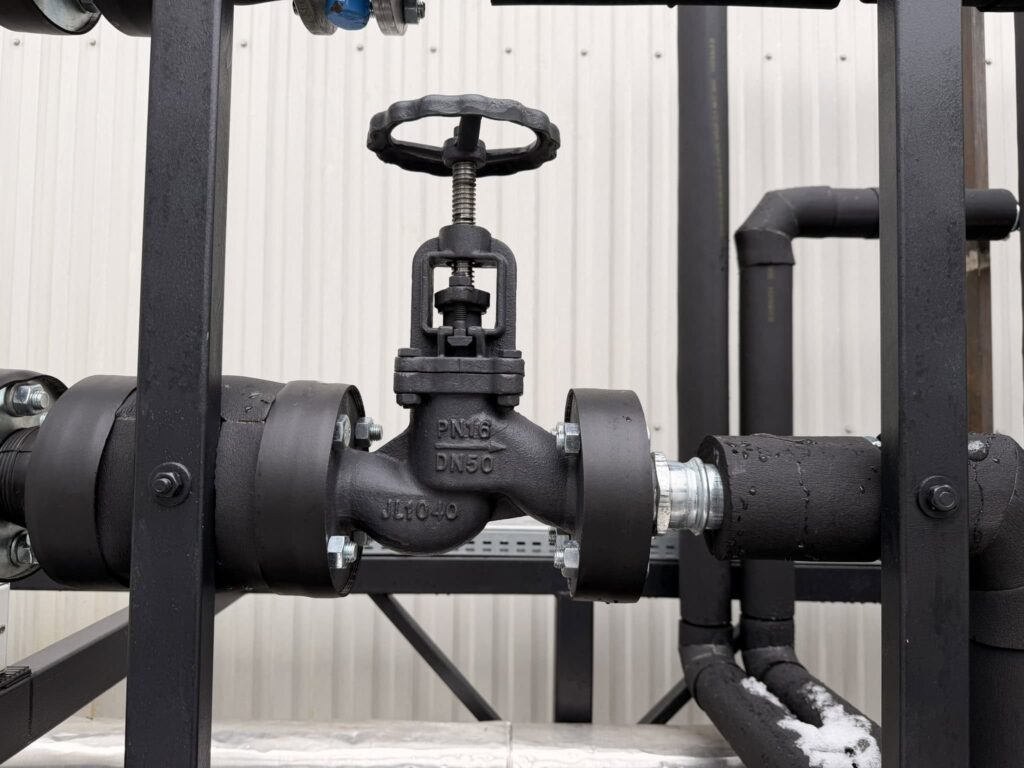
| Right after work on the installation | Valve closed or partly closed | Position of isolating and balancing valves |
| In cold weather | Frozen water, glycol too weak or too viscous | Glycol concentration and freezing point |
| Flow verified, alarm persists | Faulty or misadjusted flow switch, wiring | Switch contact, paddle, set point, cables |
Two less obvious causes are worth knowing. First, the pump inverter: after a parameter change or a power cut, a variable speed pump can settle on a speed that is too low. There is flow, but not enough, so the switch chatters open and closed and the controller eventually locks out. Second, duty and standby pumps: when the automation changes over between two pumps, the flow stops for a moment. If the flow alarm delay in the controller is too short, this changeover alone triggers a false alarm.
Fouling inside the evaporator, undersized pipework and a balancing valve set too tight have the same effect as a half-closed valve.
How much flow does your evaporator need?
To judge whether the flow switch has a reason to trip, you need a rough figure for the required flow. A simple energy balance gives it:
Q = P / (c · ΔT)
- Q is the mass flow in kg/s.
- P is the cooling capacity of the chiller in kW.
- c is the specific heat capacity of the fluid: about 4.19 kJ/(kg·K) for water and about 3.7 kJ/(kg·K) for 30 % glycol.
- ΔT is the temperature difference between chilled water return and supply, most often 5 K.
Worked example: a 200 kW chiller with plain water and a 5 K design difference needs 200 / (4.19 · 5) = 9.55 kg/s. With a density of about 1,000 kg/m³ that is roughly 34.4 m³/h. With 30 % glycol (c ≈ 3.7 kJ/(kg·K), density ≈ 1.04 kg/l) the same chiller needs 200 / (3.7 · 5) = 10.8 kg/s, which is about 37.4 m³/h, or roughly 9 % more.
The same formula works backwards and gives your team a quick plausibility check without any flow meter. If the chiller runs at full load and the difference between return and supply is around 5 K, the flow is close to design. If the difference climbs to 8 or 9 K at the same load, the flow has dropped to roughly 55 to 60 % of design and the flow switch will soon trip. In a 200 kW system that means only about 21 m³/h instead of 34 m³/h.
Without a flow meter, a service engineer measures the pressure drop across the evaporator and compares it with the manufacturer’s curve. If the measured flow is clearly too low, the problem lies in the hydraulics, not in the sensor.
Winter: air, freezing and glycol
Flow alarms become more frequent in the cold season. Parts of the circuit are shut off at low load, and chillers that stood idle for weeks release sediment into the strainer at the first restart. Running the pump alone for a few minutes before starting the compressors avoids many of these alarms.
Air is the second winter problem. After topping up or replacing the fluid, air collects at the highest points of the circuit, the pump starts to cavitate and the flow switch reads the interrupted flow as a fault. Cold glycol adds a third effect: its viscosity rises at low temperature, so a mixture that is too strong or a pump that was sized tightly will deliver noticeably less flow in January than in July.
The most serious case is freezing: an outdoor chiller with plain water or diluted glycol can freeze in the pipes or the evaporator, and the flow alarm is only the first symptom. Checking the glycol with a refractometer before winter is cheap insurance.
What your maintenance team can check
Several causes can be ruled out on site without touching the refrigerant circuit:
- Read the alarm history: does the alarm come at start, during operation or only at part load? Note the time and the operating state.
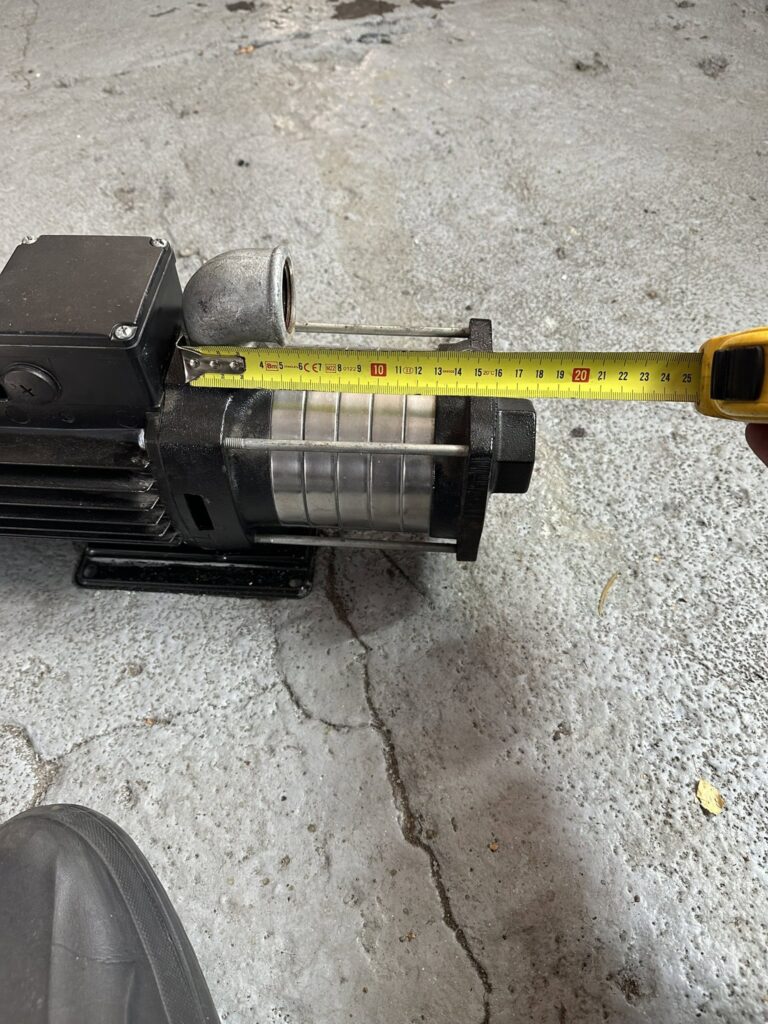
- Check the pump: is it running, has the motor protection tripped, is the direction of rotation right after electrical work?
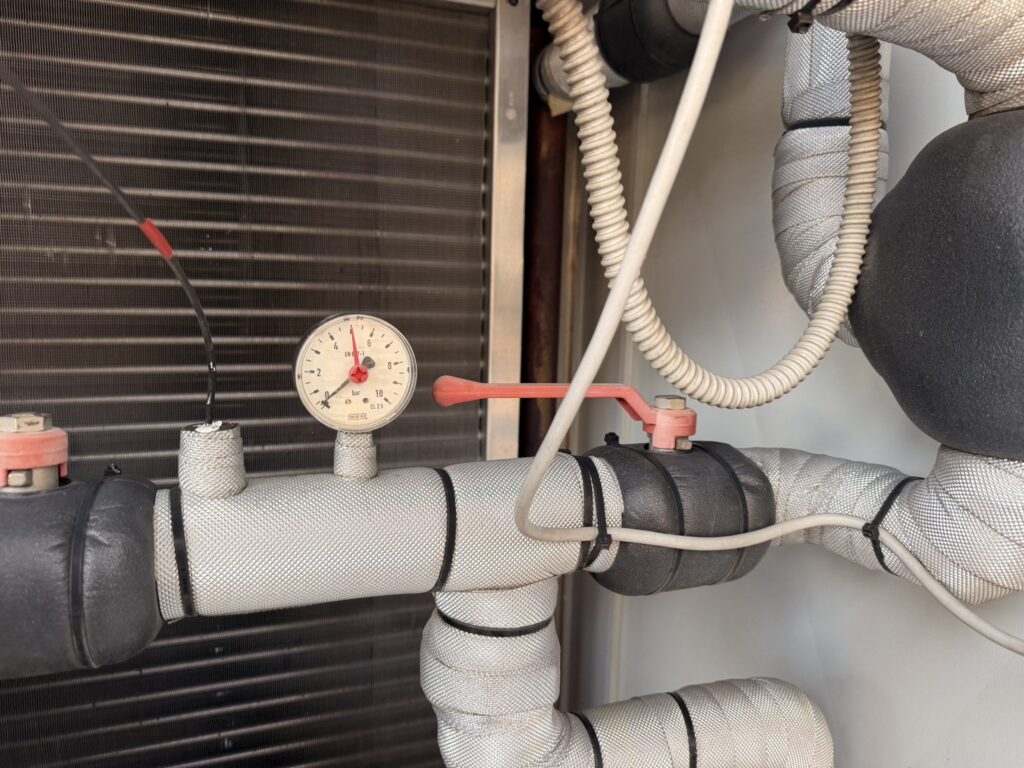
- Read the system pressure on the gauge and top up if it is below the set value, then look for the leak.
- Clean the strainer in front of the evaporator after isolating that section.
- Check the position of every isolating and balancing valve in the evaporator circuit, especially after alterations.
- Vent the circuit at its highest points and check the pressure again.
If the strainer clogs again within days, the circuit is carrying too much dirt and a chilled water system flushing together with a fluid check is the lasting fix.
When a refrigeration engineer is needed
If the alarm returns after these steps, repeated resets only stress the compressor and put the evaporator at risk. A service engineer measures the real flow, tests the flow switch and its switching point, checks the controller and the pump inverter, analyses the glycol and assesses whether the evaporator is fouled. Low flow also lowers the evaporating pressure, so a flow alarm and a low pressure alarm often appear together; telling cause from consequence is part of the diagnosis. If the pump turns out to be too small for the installation or the pipework no longer suits it after an extension, you get a concrete recommendation instead of parts swapped on suspicion.
Under the F-gas Regulation (EU) 2024/573, any work on the refrigerant circuit, including connecting gauges and recovering refrigerant, is reserved for certified personnel. Work on the water side, such as cleaning the strainer or venting, is the operator’s job and needs no certification.
An on-site diagnosis of a recurring flow alarm starts at 800 EUR net and includes measurements on the water side, a check of the flow switch and the controller and a written report. Additional working time is charged at 115 EUR net per hour and travel at 0.75 EUR net per km. More about the scope of our work is on the chiller repair page.
Frequently asked questions
Can I bridge the flow switch until the engineer arrives?
Why does the flow alarm mostly appear in winter?
What does “Evaporator Water Flow Lost” mean?
How do I know whether the flow switch itself is faulty?
What information helps you assess the problem remotely?
Does your chiller keep stopping on a flow alarm? Send us the manufacturer, model, alarm message and site location through the contact form or to info@chillerserwis.com. We will tell you whether your team can fix the cause or whether a site visit is needed.