
The expansion valve decides how much refrigerant reaches the evaporator. When it feeds too little, the chiller loses capacity and the compressor runs hot. When it feeds too much, liquid returns to the compressor. Both cases are often blamed on the valve, yet in about half of our call outs the valve itself is fine and the fault lies in a sensor, the filter drier or the refrigerant charge. This article answers the questions operators ask us most often.
What does the expansion valve do in a chiller?
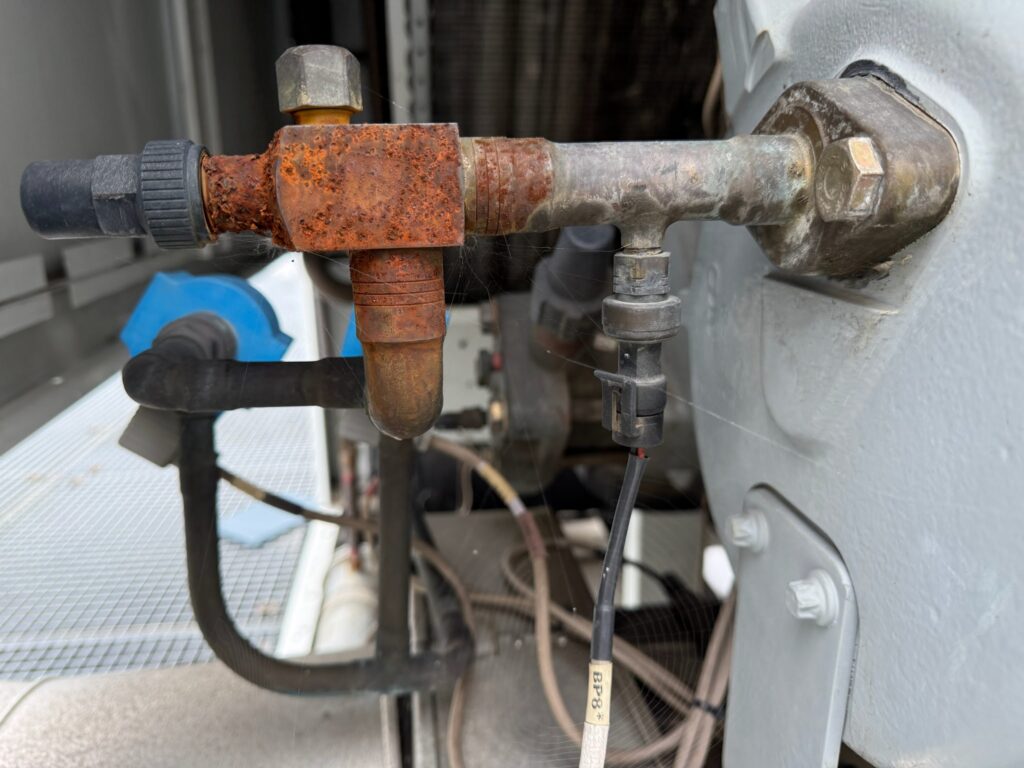
It keeps the superheat at the evaporator outlet in a narrow band. Superheat is the difference between the suction gas temperature and the evaporating temperature. In most chillers with direct expansion the target lies between about 5 and 8 K. Older units use a thermostatic valve with a sensing bulb, newer ones an electronic valve with a stepper motor, a pressure transducer and a temperature sensor on the suction line, controlled by a driver.
Which symptoms point to the valve?
| What you see | Superheat | Possible cause |
|---|---|---|
| Low suction pressure, low capacity, hot discharge line | Too high | Valve underfeeds, blocked drier, short of refrigerant |
| Frost or sweat on the compressor body, knocking noise | Close to zero | Valve overfeeds, sensor reads wrong, bulb loose |
| Suction pressure swings every few minutes | Hunting | Wrong driver settings, oversized valve, low load |
| Valve position stays at 0 or 100 % | Out of range | Stepper motor, cable or driver fault |
How do we tell a valve fault from other causes?
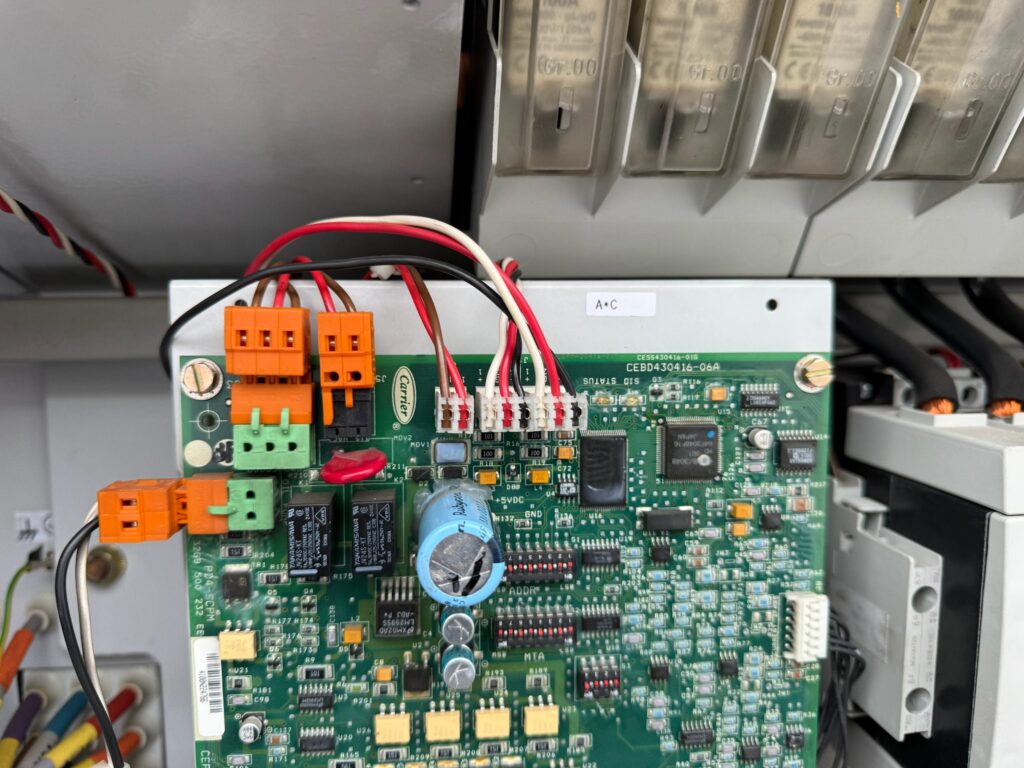
We measure the circuit at stable load and compare the readings of the controller with our own instruments. A suction temperature sensor that reads 3 K too warm makes the driver open the valve too far, and the result looks exactly like a faulty valve. A partly blocked filter drier shows a temperature drop across the drier and bubbles in the sight glass even with a full charge. A refrigerant shortage shows low subcooling at the condenser outlet. Only when sensors, drier and charge are correct do we test the valve: on an electronic valve we drive it manually through its range and listen and measure, on a thermostatic valve we check the bulb mounting, the insulation and the static superheat setting.
Can a faulty valve damage the compressor?
Yes. Long periods with very high superheat raise the discharge temperature and age the oil. Liquid floodback dilutes the oil, washes the bearings and can break valves or scrolls. That is why we look at the compressor oil and the discharge temperature during every expansion valve diagnosis, see also high discharge temperature.
Repair or replace?
A thermostatic valve with a lost bulb charge is replaced. Electronic valves are often repaired by replacing the stepper motor, the cable or the driver, which costs less than a complete valve body. After any work in the circuit we fit a new filter drier, test with nitrogen, evacuate and set the superheat under load. On older units with a thermostatic valve that hunts at part load, a retrofit to an electronic valve can stabilise operation, and we discuss this option with you before ordering parts.
A screw chiller tripped on low pressure every morning. The electronic valve had already been replaced by another company. Our measurement showed the suction pressure transducer reading 0.4 bar too high, so the driver kept the valve almost closed at start up. A new transducer and a corrected start opening solved the problem in one visit.
What does the diagnosis cost?
On site diagnosis starts at 800 EUR net, a working hour is 115 EUR net and travel 0.75 EUR net per km. Parts are quoted before installation. Related faults: low pressure alarm, short cycling and our chiller repair service.
More questions about expansion valves
Can I adjust the superheat myself?
How long does an electronic expansion valve last?
Why does the valve hunt only in winter?
Do you work on all chiller brands?
Describe the symptoms and send the alarm list through the contact form or to info@chillerserwis.com.