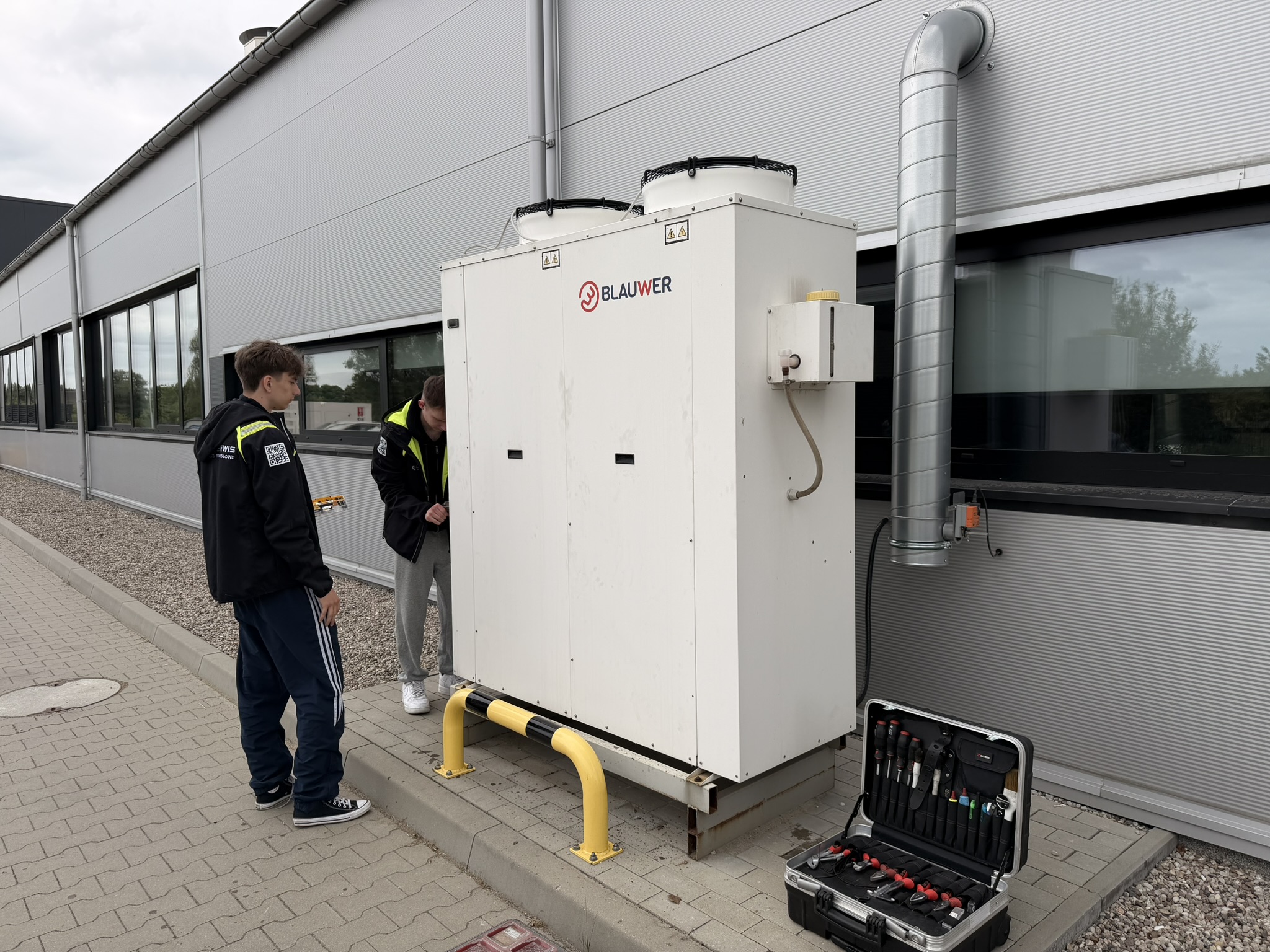

A chiller that needs topping up every few months has a leak, even if nobody can see oil stains or hear a hiss. Each refill costs money, the cooling capacity drops a little more every week and under the F-gas Regulation (EU) 2024/573 a known leak has to be repaired without undue delay. Adding refrigerant is not a repair. Below is the order of work we follow on site, step by step, so you know what to expect and what to prepare.
Signs that the chiller is short of refrigerant
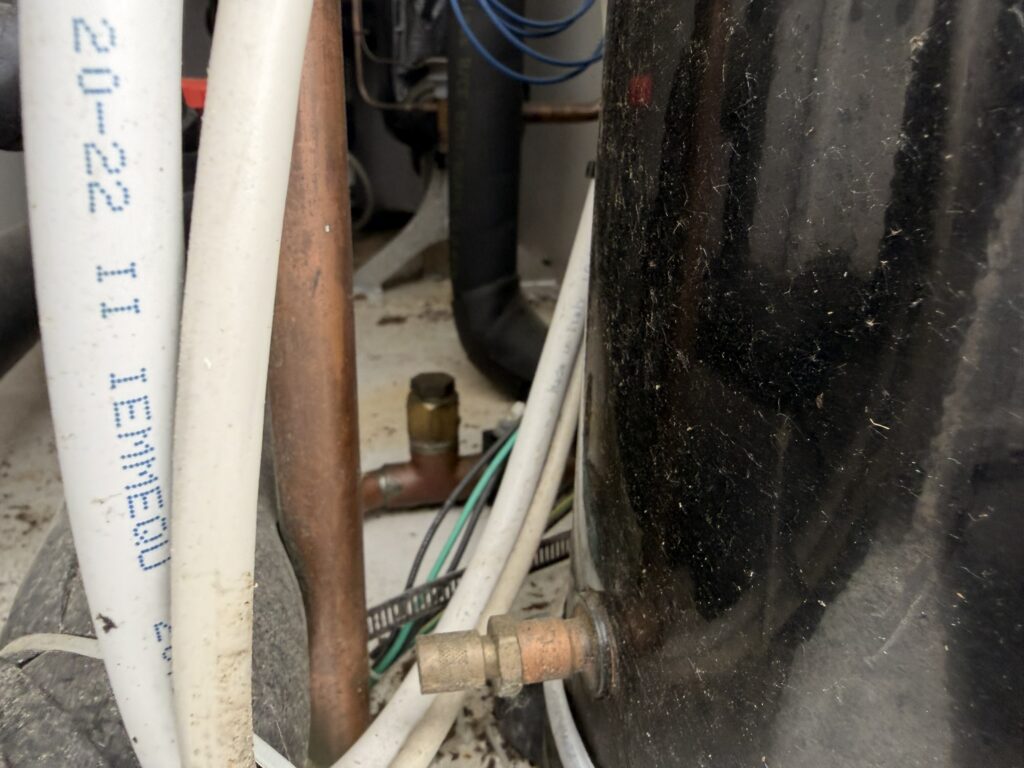
The first symptoms are rarely dramatic. Suction pressure sits lower than usual, superheat climbs, the compressor runs longer to reach the setpoint and on hot days the unit trips on low pressure. Bubbles in the sight glass of a running circuit, frost on the expansion line or an oily film on a flare joint point in the same direction. Many controllers log low pressure alarms with a time stamp, and a growing number of them across the season is a strong hint. If two circuits of the same chiller behave differently under the same load, the weaker one is usually the leaking one.
Step 1: reading the data before we touch the circuit
We start with the alarm history, the F-gas records and the amount of refrigerant added in the last two years. Then we measure the running circuit: suction and discharge pressure, superheat, subcooling and the water temperatures in and out. These figures tell us whether the shortage is small or serious and whether the unit can keep running safely while we search. A chiller with very low subcooling and high superheat should not be pushed through a summer peak.
Step 2: locating the leak
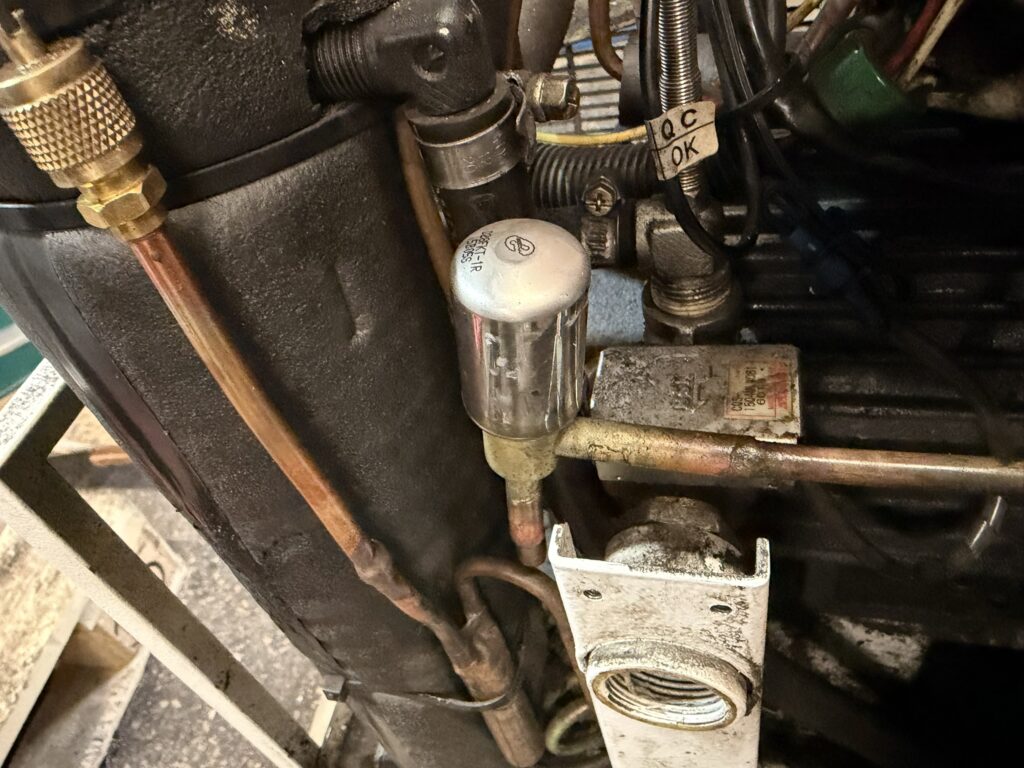
No single method finds every leak, so we combine them:
- an electronic detector along all joints, valves, sensors and capillaries, with the fans stopped so the air does not blow the gas away,
- bubble solution on suspicious points to confirm the exact spot,
- a pressure test with dry nitrogen or forming gas (95 % nitrogen, 5 % hydrogen) when the circuit is empty or the leak is too small for the detector,
- a check of the evaporator: if refrigerant appears in the chilled water or the water side shows gas, the plate or shell and tube heat exchanger itself is leaking.
Typical places we find leaks: Schrader valves and their caps, flare nuts on pressure transducers, vibrating capillary lines, brazed joints near the compressor and the coil bends of the air cooled condenser, where aluminium fins and copper tubes rub against each other.
Step 3: the repair itself
The refrigerant is recovered into a certified cylinder and weighed, so the record shows exactly how much was in the circuit. Then we repair the cause, not only the symptom: a cracked capillary gets a new route and a clamp, a porous brazed joint is cut out and brazed again under nitrogen flow, a leaking valve core or transducer is replaced. A leaking condenser coil can sometimes be repaired locally. If the corrosion is spread over the whole coil, we quote a replacement instead, because the next leak would only be a matter of weeks.
Step 4: pressure test, vacuum and recharge
| Stage | What we do | Why it matters |
|---|---|---|
| Strength and tightness test | Nitrogen at the test pressure from the nameplate, held and logged | Proves the repair and the rest of the circuit are tight |
| Evacuation | Deep vacuum with a micron gauge, standing test | Removes air and moisture that damage oil and compressor |
| Filter drier | New drier after every opening of the circuit | Catches moisture and particles left after the work |
| Charging | Charge by weight to the nameplate, then fine tuning by subcooling | Correct charge means full capacity and stable operation |
An air cooled chiller lost about a quarter of its charge every season and had been topped up three times. The detector found nothing with the fans running. After a nitrogen test with the fans stopped we found two worn coil bends at the bottom row of the condenser, hidden behind the frame. After the repair and a new drier the unit kept its charge through the next summer.
Step 5: F-gas records and the follow up check
Every repair ends with an entry in the equipment record: date, the leak found, the work done, the amount recovered and charged. Under Regulation (EU) 2024/573 a repaired leak must be checked again within one month of the repair. Leak check intervals depend on the charge in tonnes of CO2 equivalent: at least every twelve months from 5 t, every six months from 50 t and every three months from 500 t, with longer intervals if an automatic leak detection system is installed. We can take over these checks for you, see F-gas leak checks.
Costs and how to book
On site diagnosis starts at 800 EUR net, each working hour is 115 EUR net and travel is 0.75 EUR net per km. Refrigerant, filter drier and parts are charged at cost with a short quote before we start. Crews leave from Poland (Wałsnów and Szczecin). Small units can be brought to our workshop, see workshop repairs. Related faults are described in chiller low pressure alarm and on the chiller repair page.
Questions about refrigerant leaks
Can we just top up the refrigerant and repair the leak later?
How long does it take to find a leak?
Is UV dye a good method?
What happens if the evaporator is leaking?
Your chiller keeps losing refrigerant? Send us the model, serial number and the amounts added so far through the contact form or to info@chillerserwis.com and we will plan the visit.