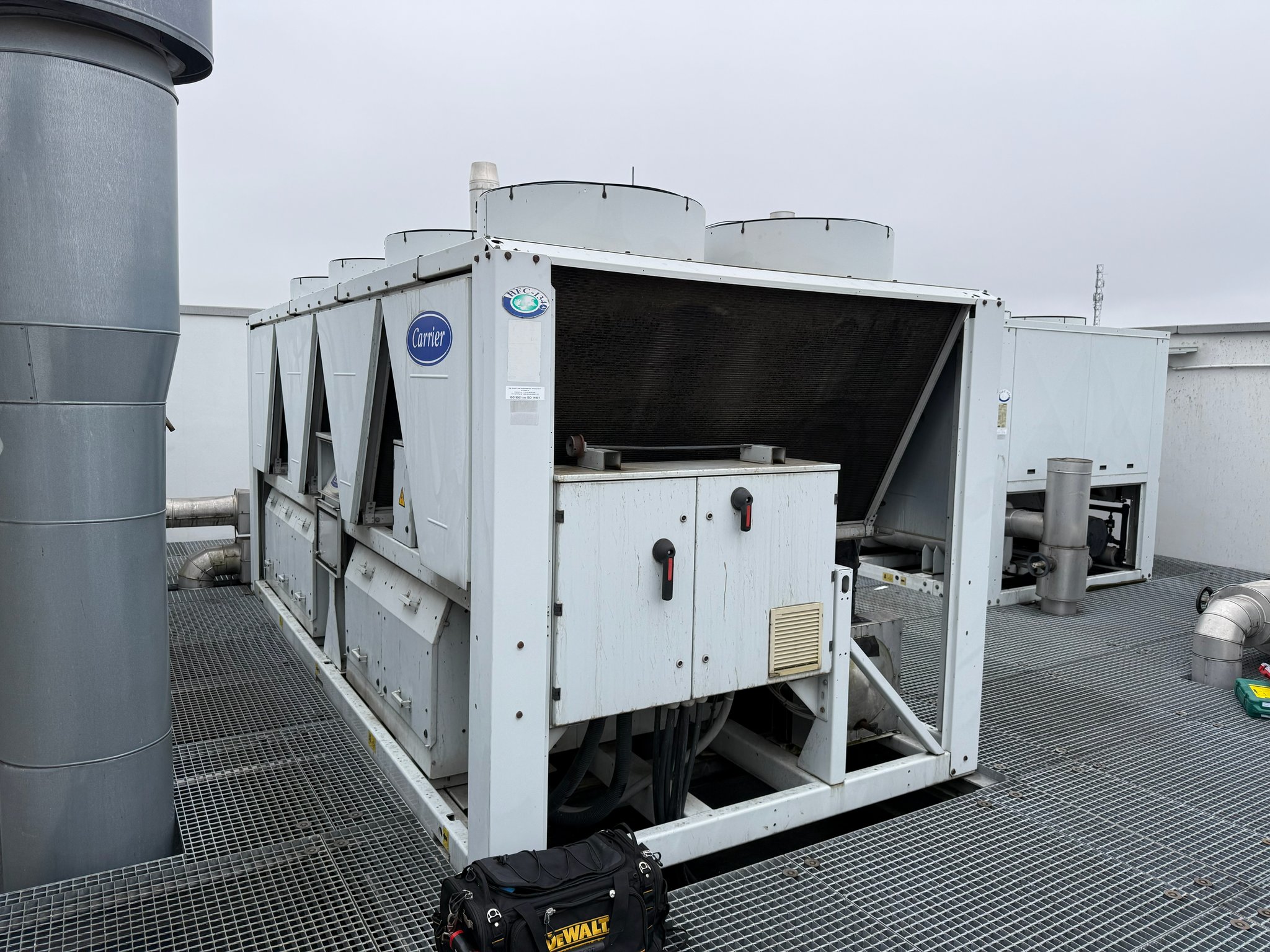

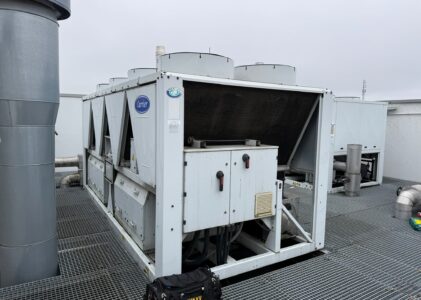
A chiller high pressure alarm stops the compressor, the chilled water starts to warm up and the display shows HP, High Pressure, High Discharge Pressure or a manufacturer code. On air-cooled units the cause sits in the condenser in most cases: a fouled coil, a fan that stopped, warm air recirculating around the unit. Overcharge, non-condensable gases and faulty sensors follow. Resetting the alarm over and over does not fix any of these. This article explains what the high pressure switch protects, which pressures are normal for R410A, R407C and R134a, in which order we diagnose the fault and what your maintenance team can check before calling a refrigeration engineer.
What the high pressure alarm actually means
Every chiller has a safety device on the discharge side of the compressor. It is either a mechanical high pressure switch (HP pressostat) or a pressure transducer read by the controller, and usually both. When the condensing pressure exceeds the cut-out value, the compressor stops. The mechanical switch is the last line of defence: it is wired directly into the compressor safety chain and works even if the controller fails.
High condensing pressure means more than an alarm. It brings a higher discharge temperature, faster oil breakdown, a higher motor current and less cooling capacity per kW of electricity. So the trip is not a fault in itself. It tells you that the condenser cannot reject the heat the circuit has to get rid of.
Typical symptoms that operators report:
- The compressor runs for a few minutes and stops with an HP code.
- The alarm comes only in the hottest hours of the day, often between noon and 4 pm.
- The mechanical switch must be reset by hand with the button on its housing.
- Some condenser fans turn slowly or not at all while the compressor runs.
- The chilled water temperature climbs and the process loses cooling.
Many controllers also count trips. After three or so HP alarms within a set period, the circuit locks out until someone clears it in the service menu. That lockout is the right moment to stop resetting and to find the cause.
Normal pressures and typical cut-out values
On an air-cooled chiller the saturated condensing temperature is normally 12 to 18 K above the air temperature at the condenser inlet. At 32 °C outside, a clean unit condenses at about 45 to 50 °C. If you measure 60 °C or more at the same ambient, something is wrong. The table gives approximate gauge pressures for typical condensing temperatures. For R407C, which has a temperature glide, the values are given as dew / bubble point.
| Condensing temperature | R410A (bar g) | R407C (bar g, dew / bubble) | R134a (bar g) |
|---|---|---|---|
| 40 °C | approx. 23 | approx. 14.5 / 16.3 | approx. 9.2 |
| 45 °C | approx. 26.3 | approx. 16.5 / 18.5 | approx. 10.6 |
| 50 °C | approx. 29.6 | approx. 18.7 / 20.7 | approx. 12.2 |
| 55 °C | approx. 33.3 | approx. 21 / 23 | approx. 13.9 |
| 60 °C | approx. 37.3 | approx. 23.5 / 25.6 | approx. 15.8 |
| Typical HP cut-out | 40 to 42 | 27 to 29 | 16 to 19 |
The cut-out depends on the maximum allowable pressure (PS) on the nameplate and on the manufacturer, so always check the unit documentation. Exact values for any temperature are in our refrigerant pressure-temperature table. A practical rule: if the unit runs within 2 to 3 bar of its cut-out on a normal summer day, it has no reserve left, and one dirty week or one failed fan will trip it.
Most common causes of a high pressure alarm
When the alarm keeps coming back on an air-cooled unit, we work through this list in roughly this order of probability:
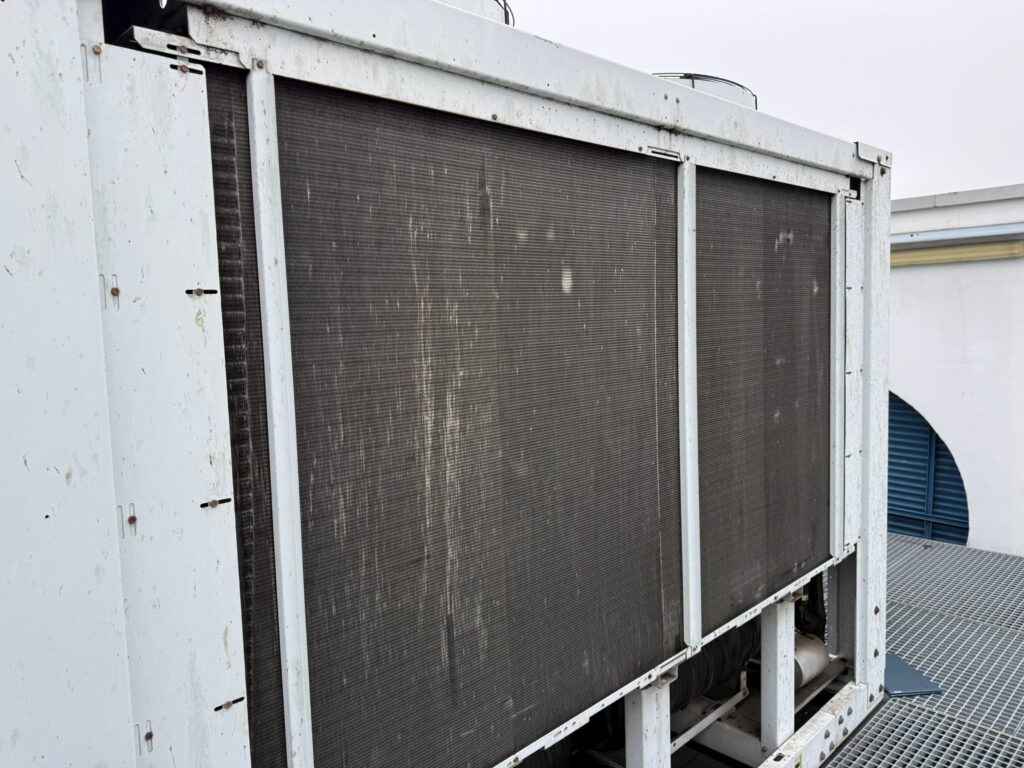
- Fouled condenser coil: dust, poplar seeds, leaves, greasy deposits from exhaust air outlets.
- Condenser fan failure: motor, run capacitor, fuse, contactor, EC fan electronics or a speed controller stuck at low output.
- Warm air recirculation: unit in a narrow courtyard, next to a wall, under a canopy or downwind of another unit.
- Refrigerant overcharge after an earlier top-up done without weighing the charge.
- Non-condensable gases (air, nitrogen) in the circuit after a repair without a proper vacuum.
- A faulty pressure transducer or a high pressure switch that drifted towards a lower value.
- A restriction on the discharge or liquid side, for example a partly closed service valve.
Water-cooled chillers have their own list: low water flow through the condenser, a closed valve, a clogged strainer, scale in the shell and tube or plate heat exchanger, a cooling tower or dry cooler that no longer rejects heat.
Causes often add up. A slightly dirty coil is fine in April, but in July, combined with one weak fan, the circuit crosses the limit. A fouled condenser also costs money long before it trips; we calculated the effect in dirty condenser energy cost.
Diagnostic sequence on site
We do not start with the refrigerant. The order below finds most faults in the first hour and avoids opening the circuit without a reason:
- Alarm history: date, time, ambient temperature and circuit for each trip. Trips only in the afternoon point to the condenser; trips at start-up point to the switch, sensor or a closed valve.
- Visual check of the coil, the space around the unit and the fans with the compressor running.
- Pressures and temperatures: discharge pressure, condensing temperature, air temperature on and off the coil, liquid line temperature.
- Subcooling. With a clean coil and all fans running, high subcooling (often above 8 to 10 K on units without a receiver) suggests overcharge. A high pressure with a large difference between the condensing temperature read from the gauge and the liquid temperature, while the coil is clean, suggests non-condensables.
- Fans and speed control: currents, capacitors, control signal (0 to 10 V or the fan stage relays), direction of rotation.
- Transducer cross-check: compare the controller reading with a calibrated gauge. A drifting sensor can raise an alarm at a perfectly normal pressure.
- Switch test: verify the actual cut-out pressure against the setting on the nameplate.
The key is to measure, not guess. The same HP code can mean a 200 EUR fan capacitor or a full recovery, vacuum and recharge. Every step that involves gauges on the refrigerant circuit falls under the F-gas Regulation (EU) 2024/573 and is done by certified personnel, followed by a leak check and a log entry.
Repair: what usually solves it
Most causes are fixed on site in one visit. We clean the coil with a method chosen for the fin type (low pressure water and a suitable cleaner, never a pressure washer close to the fins; see our condenser cleaning service), replace the fan motor, capacitor or speed controller, recover excess refrigerant and recharge by weight, or remove non-condensables by recovery, evacuation and a fresh charge. A faulty switch or transducer is replaced and its cut-out verified.
After the repair we run the chiller under load and record pressures, temperatures and compressor currents. That record becomes the reference point for the next service visit. If the unit stands in a place where warm air recirculates, we propose a practical change, such as a deflector, a different fan discharge direction or moving neighbouring equipment, instead of cleaning the same coil every month.
An on-site diagnosis starts at 800 EUR net and includes the measurements above and a written report. Additional working time is 115 EUR net per hour and travel 0.75 EUR net per km. Parts are quoted after the diagnosis, because only then is the cause known. More about the scope is on the chiller repair page.
What your maintenance team can check safely
- Remove leaves, foil or cardboard that block the coil, and check that nothing new stands next to the unit.
- Watch the fans while the compressor runs: do all of them turn, and at similar speed?
- Write down the alarm code, the time and the outdoor temperature for every trip.
- Note whether the alarm came back after one reset or after several.
- Check the date of the last coil cleaning and the last refrigerant top-up in the logbook.
Do not reset the switch again and again. If the alarm returns within minutes, switch the unit off and report it. Every further trip runs the compressor in conditions it was not built for. Look up the code first in our list of chiller alarm codes; some controllers use one code for both high pressure and high discharge temperature.
Frequently asked questions
Can I reset the high pressure alarm and keep the chiller running?
Is cleaning the condenser enough?
Why does the alarm only appear in summer?
What is a normal condensing pressure for R410A?
What should I send before a visit?
Does your chiller keep tripping on high pressure? Send the manufacturer, model, alarm code and site location through the contact form or to info@chillerserwis.com. We will tell you what to check first and whether a site visit makes sense.