The jobs below show the kind of work our technicians do every week: diagnostics, repairs, leak searches, workshop repairs and fluid replacement. They describe typical situations, not named references, because our clients expect discretion.
Each case follows the same rule: we measure first, then repair. Most of the problems we are called for have a cause that is not visible at first sight, and replacing parts without finding it usually means the fault comes back. The examples explain how we approach such jobs and what the customer receives at the end.
| Typical job | Equipment | Main tools and methods |
|---|---|---|
| High pressure alarms traced to the condenser | Air-cooled scroll chiller in a printing house | Pressure and temperature logging, condenser approach, coil cleaning |
| Compressor failure analysis | Screw chiller in a production plant | Insulation and winding tests, oil analysis, inspection of oil circuit and safety chain |
| Leak search | Rooftop unit on a warehouse or retail roof | Electronic detector, bubble solution, nitrogen pressure test |
| Workshop repair | Compact laser or machine chiller | Full disassembly, brazing under nitrogen, vacuum, charging by weight, test run |
| Glycol replacement | Process cooling circuit in a plastics plant | Refractometer, pH test, draining, flushing, filling and venting |
Scroll chiller in a printing house: high pressure alarms in summer
Printing presses need stable cooling of inking rollers and dampening solution, so a chiller that trips in the afternoon stops production. In a typical case the customer reports high pressure alarms only on warm days, always resettable, and nothing wrong in the morning.
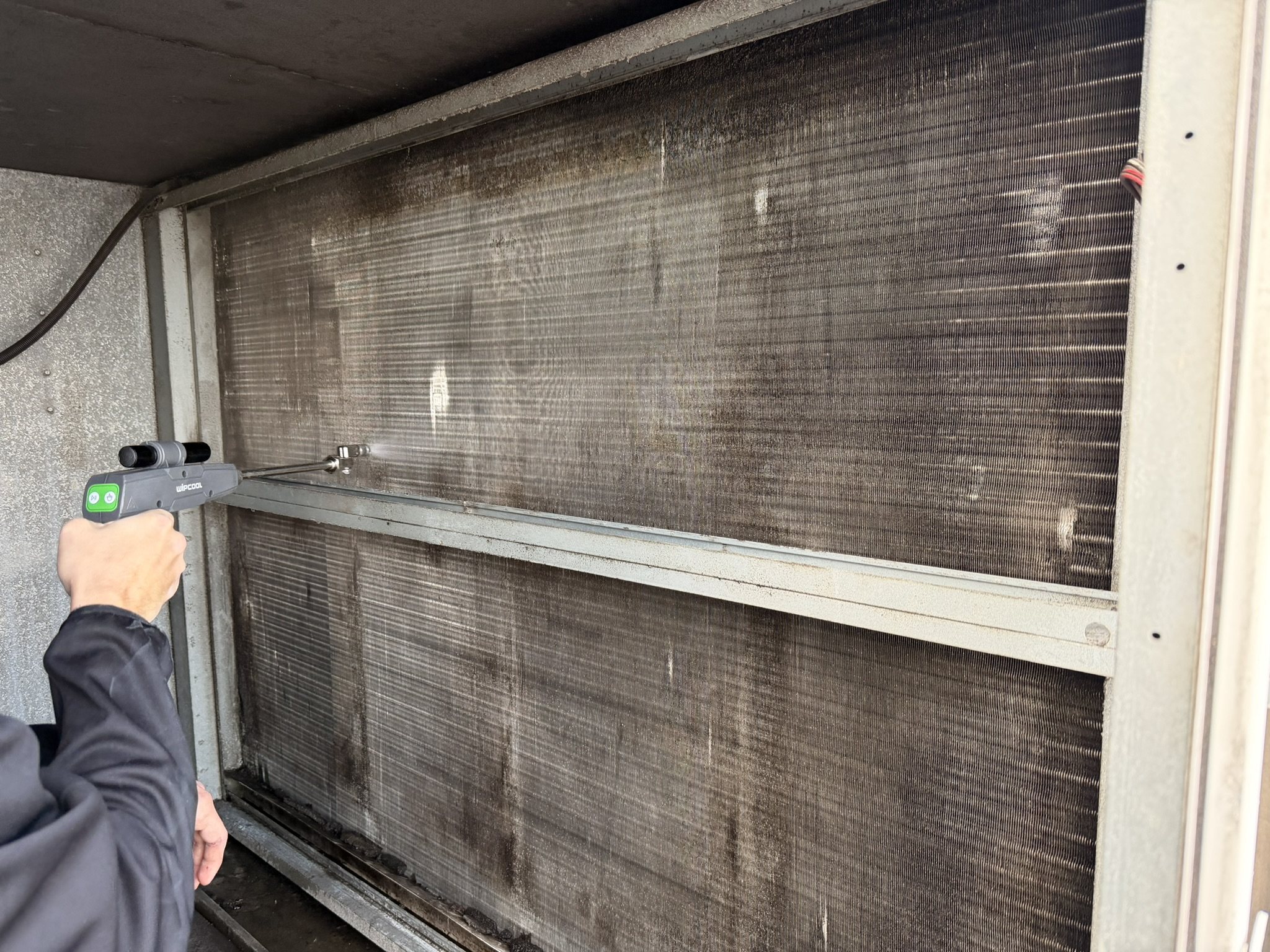
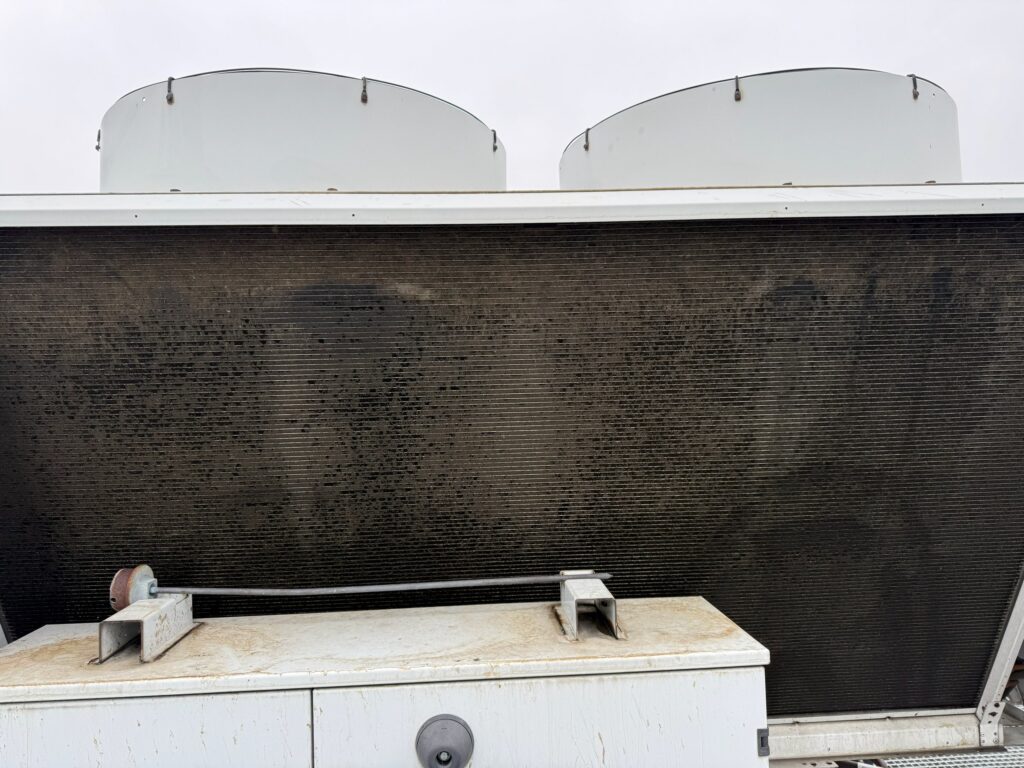
We connect gauges and temperature probes and record condensing pressure, discharge temperature and ambient temperature while the load rises. The difference between condensing temperature and ambient air is far above the normal 10 to 15 K. A visual check of the condenser coil from the fan side usually shows little, while the air inlet side is covered with a felt-like layer of paper dust, ink mist and pollen. One condenser fan may also run slowly due to worn bearings.
The repair consists of cleaning the coil with low pressure water and a suitable cleaner from the air outlet side, replacing the faulty fan, and checking the refrigerant charge by superheat and subcooling once the condenser works properly. A control measurement after the work confirms that condensing pressure follows ambient temperature again. The report includes recommended cleaning intervals for the site. Printing-specific cooling is described on our printing industry page.
Screw chiller: compressor failure analysis
When a screw compressor fails, the first question from management is usually how fast a new one can be installed. Our first question is why the old one failed. Without that answer, a new compressor costing many thousands may fail for the same reason.
A typical analysis covers:
- Electrical tests: insulation resistance of the motor windings, winding resistance balance, condition of contactors, soft starter or star-delta circuit.
- Oil: colour, smell, acidity test and the presence of metal particles in the oil filter and separator.
- Operating history: alarm log of the controller, run hours, starts, and recorded discharge temperatures before the failure.
- Oil circuit: oil level switches, solenoid valves, oil heater and oil separator condition.
- Refrigerant side: signs of liquid return, faulty expansion valve or wrong superheat setting.
The outcome is a written statement of the most likely cause and a recommendation: compressor replacement with additional parts that must be renewed at the same time, an overhaul, or modernisation of the unit if the age and condition do not justify a large investment. The customer decides on the basis of facts, not guesses. Repairs of this type are described on our chiller repair page.
Rooftop unit: leak search
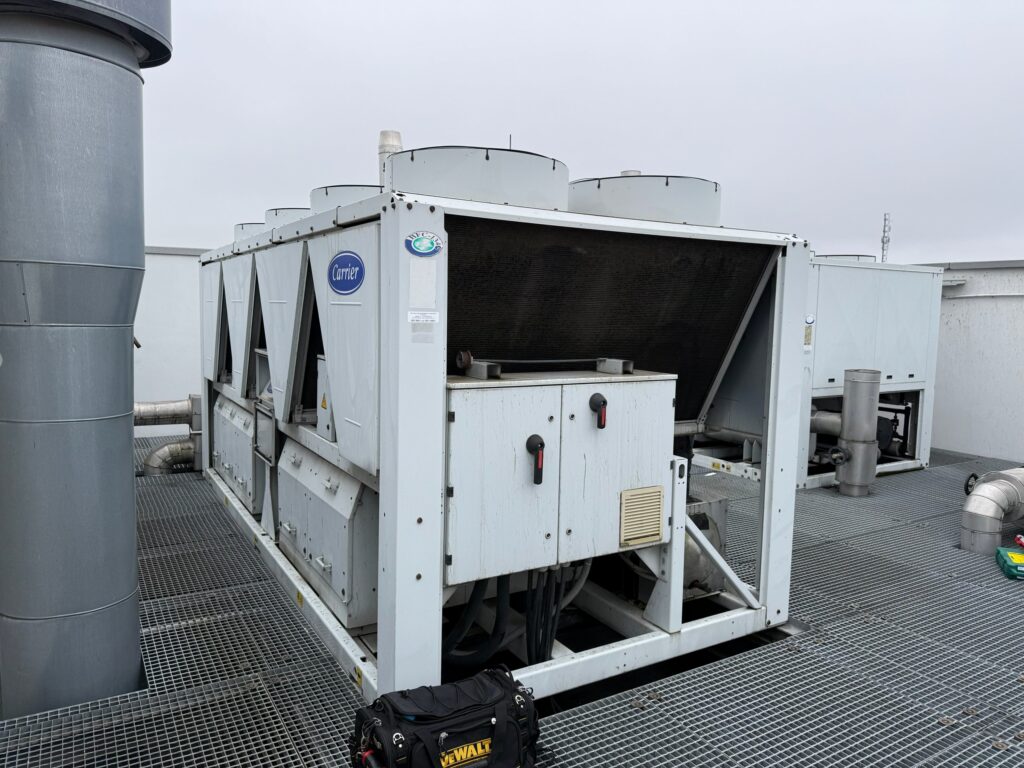
Rooftop units on supermarkets, logistics halls and factories often lose refrigerant slowly: the unit cools less every summer and somebody tops it up. Under the F-gas regulation a detected leak must be repaired without undue delay and the repair verified, so repeated topping up is not a solution.
We start with an electronic leak detector on all joints, valves, service ports and coils, followed by bubble solution to pinpoint the leak. Typical findings are vibration cracks on capillary tubes and pressure switch lines, worn Schrader cores, corroded coil return bends and loose flare joints. If nothing is found with the unit running, the circuit is recovered, pressurised with dry nitrogen and checked again section by section. After the repair we evacuate, charge by weight and record the amount in the equipment records.
Workshop repair of a laser chiller
Compact chillers for fibre lasers, CNC spindles and welding machines can often be repaired faster in a workshop than on site. The customer sends the unit, or we collect it, and it is repaired at our workshop in Wałsnów.
Typical faults in these units are a leaking plate heat exchanger after freezing, failed fan motors, defective temperature sensors, water pumps with worn seals and refrigerant leaks at vibration points. In the workshop we test the refrigerant circuit under nitrogen, repair by brazing under a nitrogen purge, replace the filter drier, evacuate to a deep vacuum and charge by weight according to the nameplate. The water circuit is cleaned and the unit runs a test with a load before it goes back. Details of this process are on our workshop repairs page.
Glycol replacement in a plastics processing plant
Injection moulding and extrusion lines use chilled water or glycol for tools and hydraulic oil coolers. In older plants the circuit has often been topped up with tap water for years. During an inspection we measure a concentration far too low for winter protection, a pH below the safe range and a dark fluid with sediment.
The job is planned for a production stop. We drain the old fluid into containers for disposal, flush the system, clean strainers, fill with fresh inhibited glycol at the agreed concentration and vent the circuit carefully, including the moulds and quick couplings that trap air. After circulation we measure the concentration and pH again and record the values in the report.
What every job has in common
After each visit the customer receives an electronic report in English, signed on site, with the measured values, photos, a description of the work done and recommendations with priorities. If further work is needed, a separate quote follows. This makes it easy for maintenance teams to justify decisions internally and to compare the state of the equipment from one visit to the next.
Frequently asked questions
Can you give us references from similar plants?
We do not publish client names, but on request we can describe comparable jobs in more detail and explain our approach for your type of equipment.
Do you repair the unit during the first visit?
Often yes, if the cause is clear and the parts are available. For larger repairs such as compressor replacement, the first visit ends with a diagnosis and a quote.
Which brands do you work on?
We are independent and service units of all brands after the end of the manufacturer warranty.
Do you work in production plants with strict safety rules?
Yes. Our technicians have health and safety training and follow the permit to work and lockout procedures of the plant.
Do you have a similar problem?
Describe the symptoms and send a nameplate photo, and we will suggest how to approach it.