
Estimate how much electricity a chiller uses and what it costs per year from its cooling capacity, efficiency, average load, operating hours and your electricity price.
Chiller electricity use and running cost
Estimate for planning. Real consumption depends on the outdoor temperature, the water temperatures and the condition of the unit.
The formula
A chiller moves heat; it does not produce it. The electrical power needed for that is the cooling capacity divided by the efficiency:
P = Q x load / EER
Energy per year = P x operating hours
Q is the nominal cooling capacity in kW, load the average share of that capacity the plant actually needs, and EER the energy efficiency ratio, which is kW of cooling per kW of electricity. A 200 kW chiller with an EER of 3.0, running at an average 60 % load for 2,500 hours, uses 200 x 0.6 / 3.0 = 40 kW on average and 100,000 kWh per year. At 0.20 EUR per kWh that is 20,000 EUR.
Which efficiency value to use
The EER on the data sheet is measured at one fixed point, for air-cooled chillers usually 35 °C outdoor air and 12/7 °C water. The chiller rarely runs exactly at that point. Seasonal values weight several part load conditions over a typical year:
- SEER is the seasonal value for comfort chillers under the EU ecodesign rules.
- SEPR is the seasonal value for process chillers, which run more evenly through the year.
- ESEER is an older Eurovent index that you still find on many existing units.
For an annual cost estimate the seasonal value is closer to reality. The full load EER gives a conservative result, which is useful when you check the electrical supply or the worst summer month.
| Chiller type | Typical EER at full load | Typical seasonal value |
|---|---|---|
| Air-cooled, older scroll or piston units | 2.2 to 2.8 | 3.0 to 3.8 |
| Air-cooled, current scroll or screw units | 2.8 to 3.4 | 4.0 to 5.0 |
| Water-cooled, screw or scroll | 4.5 to 5.5 | 5.5 to 7.0 |
| Water-cooled, centrifugal or magnetic bearing | 5.5 to 6.5 | 7.0 and more |
These ranges are indicative. The data sheet of your unit, at your water temperatures, is the better source.
How to estimate load and hours
Comfort cooling in central Europe typically needs between 800 and 1,500 full load equivalent hours a year, depending on the building and its internal gains. In the calculator, you can enter either the real operating hours with an average load, or the full load equivalent hours with 100 % load; both give the same energy. Process chillers often run 6,000 to 8,000 hours at a fairly constant load, which makes them easier to estimate. If the plant has an energy meter on the chiller supply, a few weeks of readings give a far better basis than any estimate.
Do not forget the auxiliaries
The chilled water pump, the condenser water pump and the dry cooler fans can add 10 to 25 % to the energy of the chiller itself. Enter their electrical power in the auxiliaries field. A pump that runs all year, even when the compressors are off, is often the cheapest saving in the whole plant.
What raises the electricity bill
The efficiency of a chiller falls when the condensing temperature rises or the evaporating temperature drops. As a rule of thumb, every kelvin of higher condensing temperature costs 2 to 3 % efficiency, and so does every kelvin of lower evaporating temperature. Typical causes we find on site:
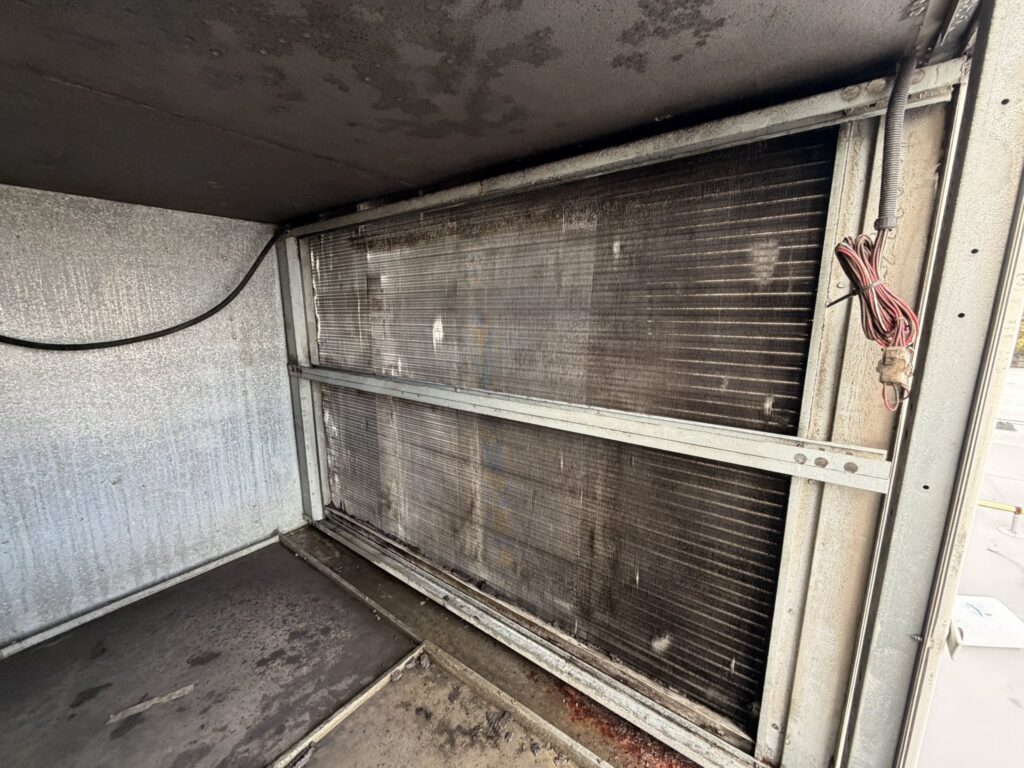
- Fouled condenser coils. A coil clogged with dust and pollen can raise the condensing temperature by 5 K or more.
- Leaving water setpoint lower than the process needs. Raising it from 6 to 8 °C saves energy every hour the unit runs.
- Refrigerant shortage, which lowers the evaporating temperature and raises superheat.
- Short cycling because of too little water volume.
- Glycol concentration higher than necessary.
The calculator shows how much a 15 % drop in efficiency costs per year. That number usually pays for regular condenser cleaning many times over. To check the capacity side of the balance, use the cooling capacity calculator.
Frequently asked questions
How much electricity does a 100 kW chiller use?
At full load, an air-cooled unit with an EER of 3 draws about 33 kW for the compressors and fans. Over a year the average is lower, because the unit runs at part load most of the time. With 60 % average load and 2,500 hours, that is about 50,000 kWh.
Is EER the same as COP?
For cooling, EER is the ratio of cooling capacity to electrical input. COP usually means the same ratio for heating, which is about one unit higher, because the compressor power ends up as heat. Do not mix them in one calculation.
Why is my measured consumption higher than the estimate?
Common reasons are auxiliaries that were not included, a lower water setpoint than assumed, fouled heat exchangers, or a unit that runs more hours than planned. A sub-meter on the chiller supply shows the real figure.
Does replacing an old chiller pay off?
It depends on the hours and the efficiency difference. A unit that runs 6,000 hours a year and gains one point of seasonal efficiency often pays back within a few years; a seasonal comfort unit with 800 equivalent hours rarely does. Check the condition of the old unit first, because a repair or cleaning sometimes recovers most of the difference.
Want to know why your chiller uses so much power?
We measure capacity, power input and the refrigerant circuit and show where the efficiency is lost.