
Free online tools for chiller and refrigeration work: alarm guidance, F-gas thresholds, refrigerant pressures, glycol, cooling capacity, buffer tanks, energy use, pipe sizing, dew point and unit conversion.
What the calculators are for
These tools come from the calculations we make every week on site and in our workshop. A technician who finds a chiller tripping on high pressure converts gauge readings into condensing temperatures. A maintenance engineer who plans the winter checks the glycol concentration against the lowest outdoor temperature. A plant manager who needs a budget estimates the yearly electricity bill of a new unit. The calculators make these steps quick and repeatable, with the formulas and assumptions written out on every page.
All tools run in your browser. Nothing you enter is sent anywhere or stored, and they work on a phone in the plant room as well as on a desktop. You can type decimal numbers with a comma or a dot.
Which tool for which question
| Question | Tool |
|---|---|
| The chiller shows an alarm. Where do I start? | Chiller alarm codes |
| How often must this unit be leak checked? | GWP and CO2 equivalent, inspection planner |
| Are the pressures I measure plausible? | Refrigerant PT table |
| Does the chiller still deliver its capacity? | Cooling capacity calculator |
| Is the glycol strong enough for winter? | Glycol calculator, glycol dilution table |
| Why does the compressor start so often? | Buffer tank calculator |
| What does the chiller cost to run? | Chiller energy use |
| Are the pipes big enough? Will they sweat? | Pipe sizing, dew point calculator |
How accurate are the results
Refrigerant saturation data were calculated with CoolProp, an open-source library based on reference equations of state. Glycol freezing points follow ASHRAE published data, and the physical properties of the mixtures come from CoolProp’s incompressible fluid models. The legal thresholds for F-gas leak checks follow Regulation (EU) 2024/573 with the GWP values from the IPCC Fourth Assessment Report, which the regulation uses.
The results are as good as the input. Three things decide most of the accuracy in practice:
- Calibrated instruments. A pressure transducer that drifts by half a bar or a thermometer that reads 0.5 K off changes superheat, capacity and efficiency results more than any rounding in a formula.
- Steady operation. Measure when the chiller runs at a stable load, not while compressors stage on and off.
- The real fluid. Measure the glycol concentration instead of assuming the value from the commissioning report.
The tools are meant for estimates, checks and planning. They do not replace the manufacturer’s documentation, a design calculation by a qualified engineer, or the safety rules for work on pressure equipment and refrigerant circuits.
From calculation to diagnosis
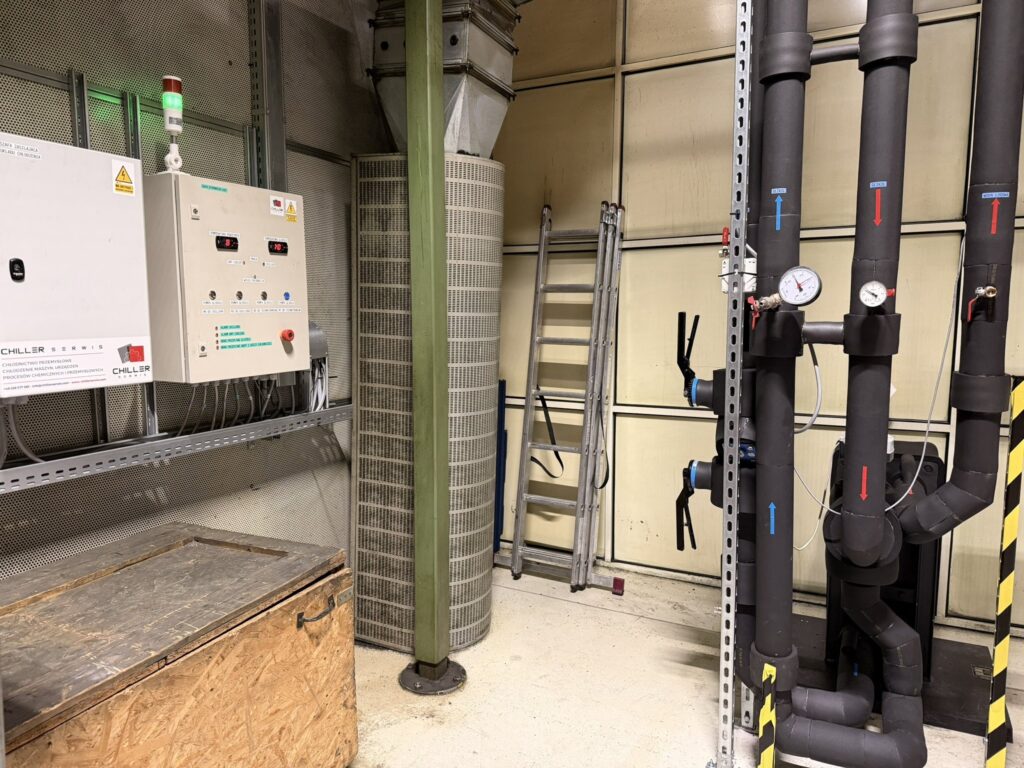
A calculation shows that something is wrong; it rarely shows why. When the capacity is below the data sheet, the condensing temperature too high or the energy bill climbing year after year, the next step is a diagnosis with measurements on the unit: pressures, temperatures, currents, water flows and a leak check. That is the core of our work. We measure first, then repair, and we leave a report in English with the values we found and photos of the unit.
If you want a second opinion on your results, send us the numbers you entered, a photo of the nameplate and a short description of the problem. More about how a visit works is on the chiller service page.
Frequently asked questions
Are the calculators free to use?
Yes, without registration. They run in your browser and do not send or store your inputs.
Can I use the results in a design or an offer?
Use them for estimates and plausibility checks. For a design, the data of the selected equipment and a full calculation by a qualified engineer are needed.
Why do some results differ from the manufacturer software?
Manufacturer tools use the exact data of their own heat exchangers and compressors, and sometimes different property data. Differences of a few per cent are normal; large differences point to an input error.
Do the tools work on a phone?
Yes. The layout adapts to small screens, and you can type decimals with a comma or a dot, so they are practical next to the unit.
Numbers do not add up?
Send us your readings and a nameplate photo and we will propose a diagnostic visit with measurements.