
A chiller can only be as reliable as the chilled water installation it is connected to. We design, install and modernise chilled water and glycol installations, from pipework and pumps to buffer tanks, and we commission them with recorded parameters.
As service engineers we see the same installation faults again and again: undersized pipes, pumps working far from their best point, no buffer volume, missing strainers, air pockets and uninsulated cold pipes dripping onto production floors. Each of these turns into chiller alarms, short cycling and premature compressor wear. When we build or rebuild an installation, we do it with these failures in mind.
Design basics
The design starts from the load, not from the chiller. We need the required cooling capacity, the supply and return temperatures, the consumers and their locations, the operating hours and whether the system must work in frost. From these data we size the flow, the pipework, the pumps and the buffer volume.
The flow follows from the capacity and the temperature difference: for water, 1 kW at a difference of 5 K needs about 0.172 m3/h. A 200 kW system with 7/12 degrees C therefore needs about 34 m3/h. With glycol the flow increases, because the specific heat of the mixture is lower than that of water, and the pressure drop rises further due to higher viscosity.
Pipework and insulation
Pipe diameters are chosen by flow velocity and pressure drop. The table gives the guide values we use for closed chilled water circuits.
| Pipe size | Recommended velocity | Comment |
|---|---|---|
| Up to DN 50 | 0.6 to 1.2 m/s | Branches to consumers, lower velocity limits noise |
| DN 65 to DN 150 | 1.0 to 2.0 m/s | Main distribution lines |
| Above DN 150 | 1.5 to 2.5 m/s | Large plant room headers, pressure drop checked separately |
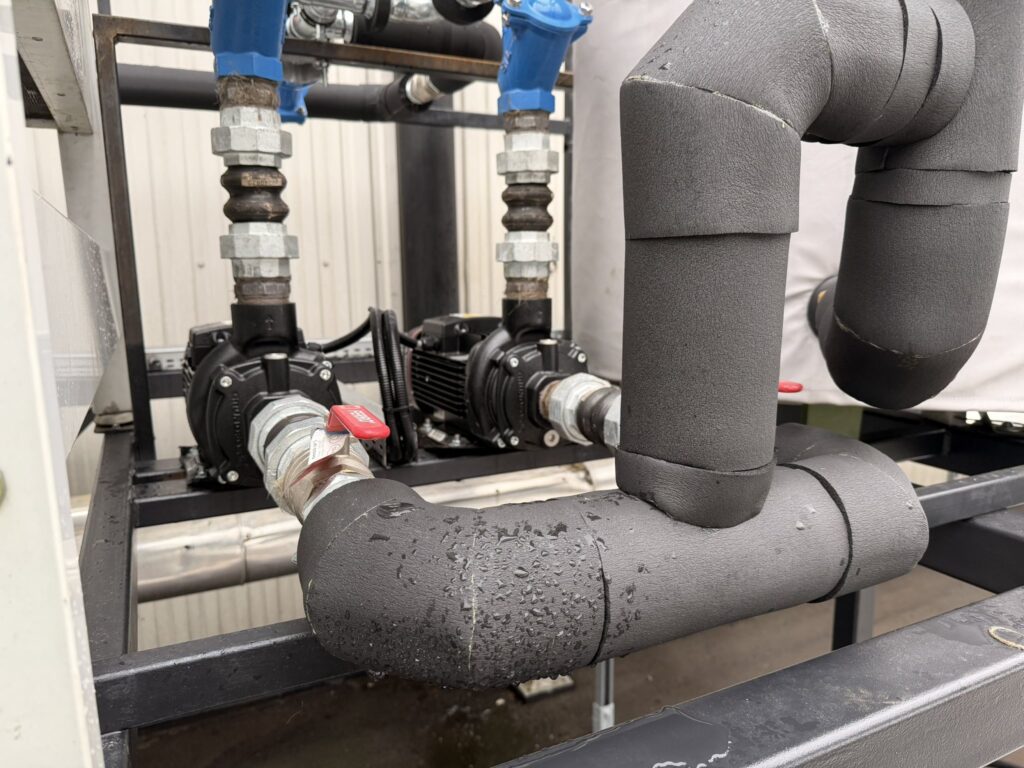
Materials are chosen for the fluid and the site: carbon steel, stainless steel, or plastic systems for glycol circuits where suitable. Galvanised pipework is avoided with glycol, because the zinc reacts with the inhibitors. Cold pipes are insulated with closed-cell insulation with a continuous vapour barrier, and the thickness is chosen so the surface stays above the dew point of the surrounding air. A pipe at 7 degrees C in a hall at 28 degrees C and 60 percent relative humidity will sweat heavily, because the dew point of that air is about 19.5 degrees C.
Pumps and buffer tanks
Pumps are selected for the calculated flow and the real pressure drop of the system, including the chiller evaporator, strainers, valves and the most remote consumer. For critical processes we install duty and standby pumps or twin pumps, with automatic changeover. Speed-controlled pumps with constant differential pressure control suit systems with two-way valves.
The buffer tank protects the chiller from short cycling. A chiller with few capacity steps and a small water volume will start and stop too often, which wears contactors and compressors. As a guide, systems need roughly 3 to 10 litres of water per kW of cooling capacity, depending on the number of compressor steps, the allowed starts per hour and the control band. We calculate the actual value for each system and decide whether the tank sits in the return line, as a hydraulic separator or in a primary and secondary arrangement.
Components every installation should have
- A strainer in front of the evaporator, with isolation valves for cleaning.
- A flow switch or a differential pressure switch across the evaporator, connected to the chiller safety chain.
- An expansion vessel sized for the system volume and temperature range, with a pressure relief valve.
- Automatic air vents at high points and an air and dirt separator in the main circuit.
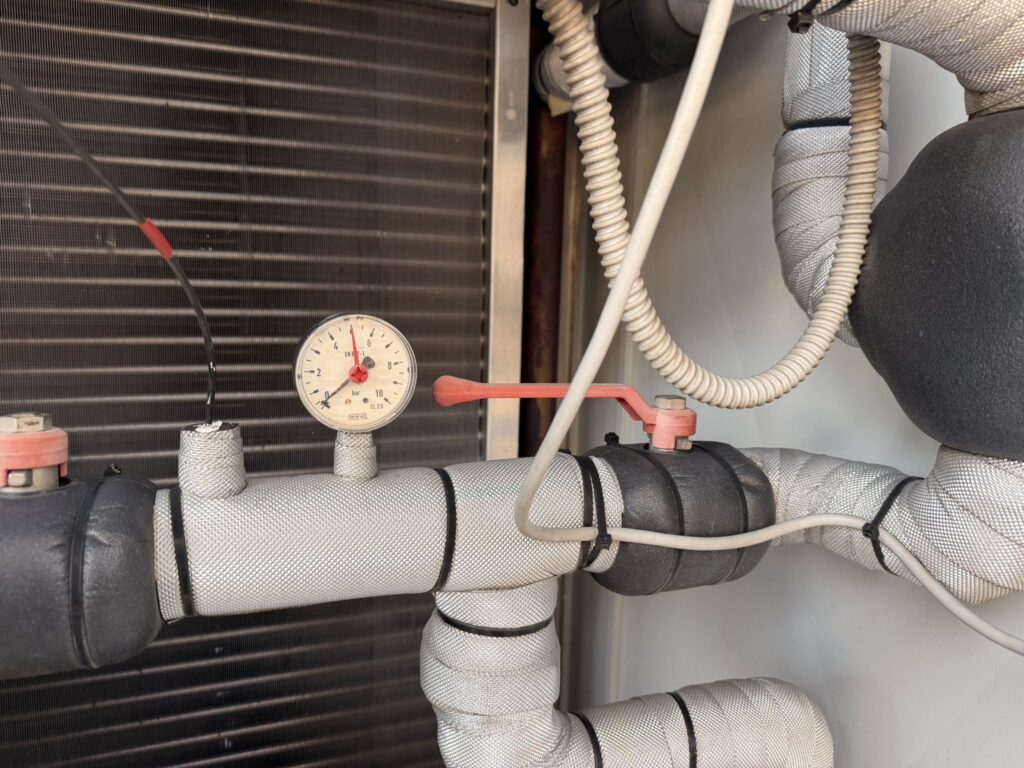
- Pressure gauges and thermometer pockets before and after the chiller and major consumers.
- Drain points at low points and a filling point with a backflow preventer.
Flushing, filling and venting
New and modified installations contain welding scale, cutting debris and installation dirt. We flush the system with the chiller evaporator bypassed, so the debris does not end up in the plate heat exchanger. Temporary fine strainers are fitted for the flushing period and cleaned until no more dirt appears.
Glycol systems are filled with a ready mixture or with concentrate and water mixed in a controlled way, never by pouring concentrate into a running system. The concentration is checked with a refractometer at several points after circulation. Venting takes time: air comes out of solution for days after filling, so we recheck pressures and vents after the first period of operation. More on fluids is on the glycol testing and replacement page.
Commissioning with recorded parameters
Commissioning ends with a record that can be used as a reference for years. It contains:
- The pressure test result of the water circuit.
- Static pressure, expansion vessel pre-charge and relief valve setting.
- Flow through the chiller, determined from the evaporator pressure drop or a flow meter.
- Supply and return temperatures and the temperature difference under load.
- Pump currents and operating points.
- Glycol type, concentration and freezing point.
- Chiller operating data: pressures, superheat, subcooling and compressor currents.
The chiller start-up itself is done by our team, as part of our chiller service. When an existing installation causes recurring chiller faults, we start with a diagnosis of the water side, as described on the chilled water unit repair page, and propose a modernisation based on the measurements.
Frequently asked questions
Can you modify an installation while the plant is running?
Partly. Many components can be added with short planned stops, and a temporary chiller can bridge longer interruptions.
Do we need a buffer tank?
Not always. If the system already has enough water volume for the chiller’s capacity steps, no tank is needed. We calculate it for your system.
Which glycol should we use?
Propylene glycol where there is any risk of contact with food or drinking water, ethylene glycol elsewhere if allowed. In both cases use an inhibited product and the concentration needed for the lowest expected temperature.
Do you install chillers as well?
Yes, we connect and start up chillers. New and refurbished units are supplied through our group company ChillerTech.
Planning a new or modernised chilled water installation?
Send us the capacity, the temperatures and a sketch of the system and we will propose the next steps.