We service air handling units with a focus on the parts that fail most and cost most: heating and cooling coils, fans and their drives, heat recovery and the controls that protect them. Winter preparation is a key part of the work, because a frozen coil can stop a whole building.
Air handling units are often forgotten until something goes wrong: a burst coil after the first frost, a fan bearing that seizes, or a control fault that leaves the building too cold or too warm. Our service is technical, not cosmetic. We measure air and water temperatures, fan currents and pressure drops, test the safety functions and report what needs to be done before it becomes a breakdown. Where the AHU is part of a wider system with chillers, dry coolers or rooftop units, see also the overview of dry coolers, rooftops and AHUs.
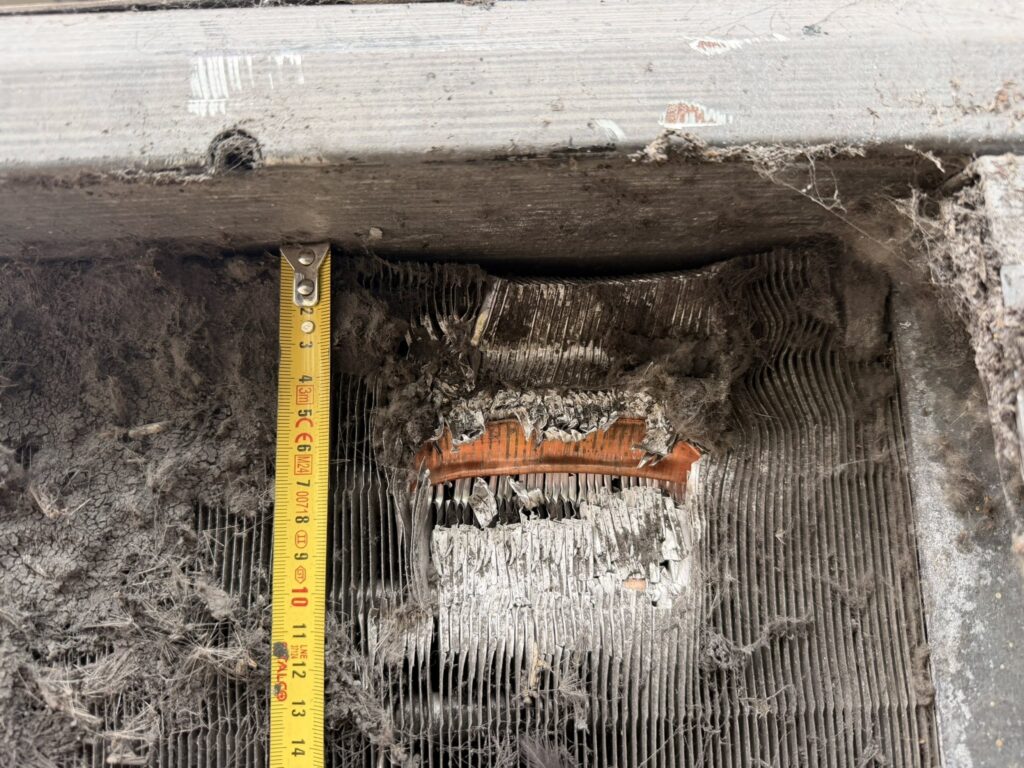
Frost damage and coil repairs
Water coils freeze when cold outdoor air meets a coil with too little warm water flowing through it. Typical causes are a heating valve that does not open, a pump failure, an outdoor air damper that stays open when the unit stops, stratification of cold air in the mixing section and a frost thermostat that is bypassed or badly placed.
What we do after a frost incident
- Locate the damage with a pressure test of the coil, isolated from the system.
- Repair split tubes and return bends by brazing where the damage is limited and accessible.
- Recommend coil replacement where the damage is spread over many tubes, with dimensions and connection positions measured for the new coil.
- Find the cause: test the frost protection chain, valve actuator, pump interlock and damper closing, so the next frost does not repeat the damage.
Coils with glycol are less sensitive, but only if the concentration is right. A glycol mixture that has been diluted by refilling with water over the years gives no real protection. We check the freezing point with a refractometer, and the follow-up is covered on the glycol testing and replacement page.
Cooling coils, DX coils and condensate
Chilled water coils are checked for air and water temperature differences, valve operation and fouling of the fins. Direct expansion coils supplied by a condensing unit get the full refrigerant circuit check: superheat at the coil outlet, capacity steps and the interlock that stops the compressor when the supply fan stops. The condensate tray, drain and trap are cleaned and tested, because a dry or wrongly sized trap lets air pull the water back into the unit. Condensing units themselves are described on the condensing unit service page.
Fans, bearings, belts and inverters
| Component | What we check | Warning signs |
|---|---|---|
| Fan bearings | Noise, temperature, vibration, lubrication where applicable | Rumbling, heat at the bearing housing, rising current |
| Belts and pulleys | Tension, alignment, wear of belts and pulley grooves | Squealing at start, black dust in the fan section, polished grooves |
| EC fans | Fault memory, control signal, speed against setpoint | Speed fluctuations, communication alarms |
| Inverters | Parameters, fault log, cooling of the drive, motor current | Overcurrent or overtemperature trips, dirty heat sinks |
| Motors | Current on all phases, insulation resistance | Phase imbalance, low insulation values |
Fan energy depends heavily on the speed: by the fan laws, power rises roughly with the cube of the speed. A small reduction of the airflow where the building allows it saves a noticeable amount of energy, so we look at the setpoints as well as the hardware.
Heat recovery
Heat recovery is where an AHU saves most energy, and where silent faults are common because the unit keeps running when it fails.
- Rotary heat exchangers: drive belt and motor, rotation sensor, brush seals, purge sector and cleanliness of the matrix.
- Plate heat exchangers: fouling, bypass damper operation and frost protection on the exhaust side.
- Run-around coil systems: glycol concentration, pump, three-way valve and the temperature efficiency against design.
We calculate the temperature efficiency from measured air temperatures. A drop of the efficiency compared with the design value is a clear sign of a fault, even when no alarm is shown.
Controls and sensors
We check sensor readings against a reference thermometer, actuator travel and response, setpoints and time schedules, and the safety functions: frost protection, fire damper signals, airflow switches and filter differential pressure switches. Filters are assessed by their pressure drop against the final value recommended for their ISO 16890 class.
Winter preparation
- Test the frost thermostat and the frost protection sequence with the unit in operation.
- Check that outdoor air dampers close tightly when the unit stops.
- Check heating valves and pumps, and the water temperature at the coil inlet.
- Measure the glycol freezing point where glycol is used.
- Check the heat recovery frost protection and the condensate drain heating.
Frequently asked questions
When is the best time for AHU service?
Early autumn, so winter preparation is done before the first frost. A second visit before the cooling season is useful where the unit has cooling coils.
Can a frozen coil always be repaired?
Not always. Local damage can be brazed; widespread damage means a new coil. The pressure test shows which applies.
Do you service fan coil units too?
No. We work on air handling units, rooftop units, chillers and the related refrigeration equipment, but not on fan coils, split or VRF systems.
Do you work on all AHU brands?
Yes, we are independent and service all brands after the warranty has ended.
Prepare your air handling units for winter
Send us the number of units and their configuration and we will propose an inspection date and price.