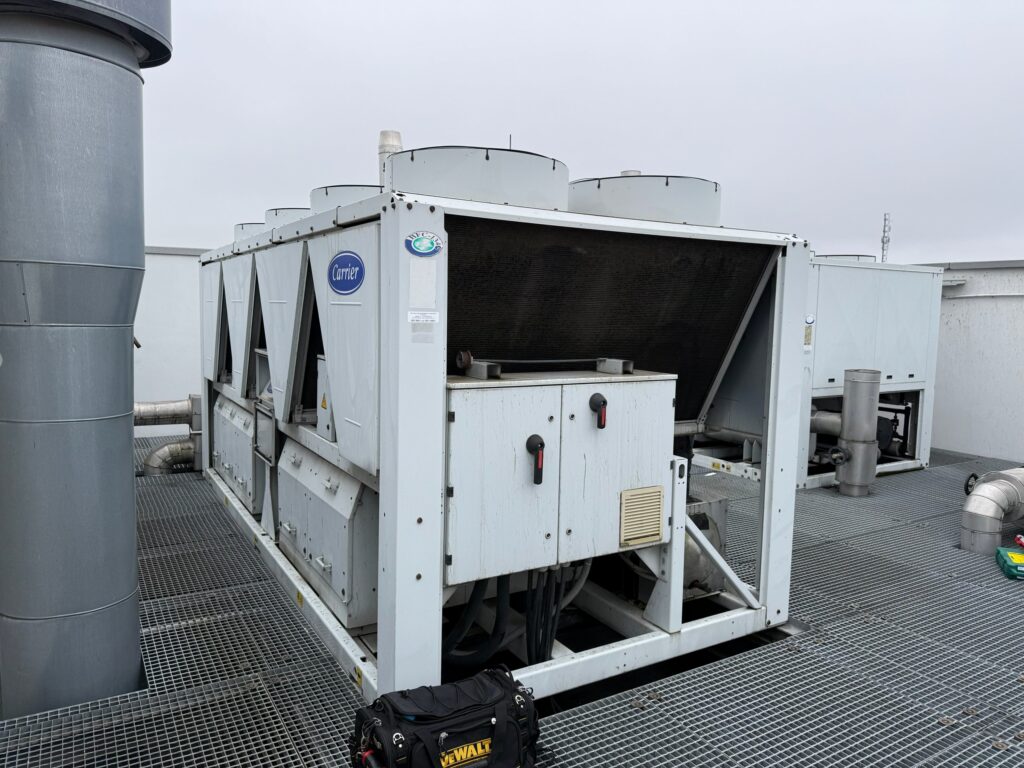
Rooftop units on factories, warehouses and retail buildings combine cooling, heating, ventilation and controls in one casing exposed to the weather all year. We inspect and repair all of these sections, starting with measurements and the controller’s alarm history.
A rooftop unit works hard: it cools in summer, heats in winter, moves large volumes of air every day and stands in rain, frost and sun. Faults usually come from wear and dirt rather than from sudden breakdowns, which means most of them can be found during an inspection before the unit stops. This page covers rooftop units specifically. For the wider group of equipment on the roof, including dry coolers, see our overview of dry coolers, rooftops and AHUs.
Refrigerant circuit and compressors
Most rooftop units have one to four scroll compressors on one or two refrigerant circuits, often with R410A, in newer units R32 or R454B. Many are reversible heat pumps with a four-way valve. We check each circuit under load:
- Evaporating and condensing temperatures, superheat and subcooling in cooling mode, and in heating mode where the weather allows.
- Compressor currents on all phases against the nameplate values.
- Four-way valve switching and the temperature difference across it, to detect internal leakage.
- Defrost operation on heat pump units: start conditions, duration and termination.
- Leak checks of all joints, service valves and pressure transducer connections, as required by the F-gas regulation for the given CO2 equivalent.
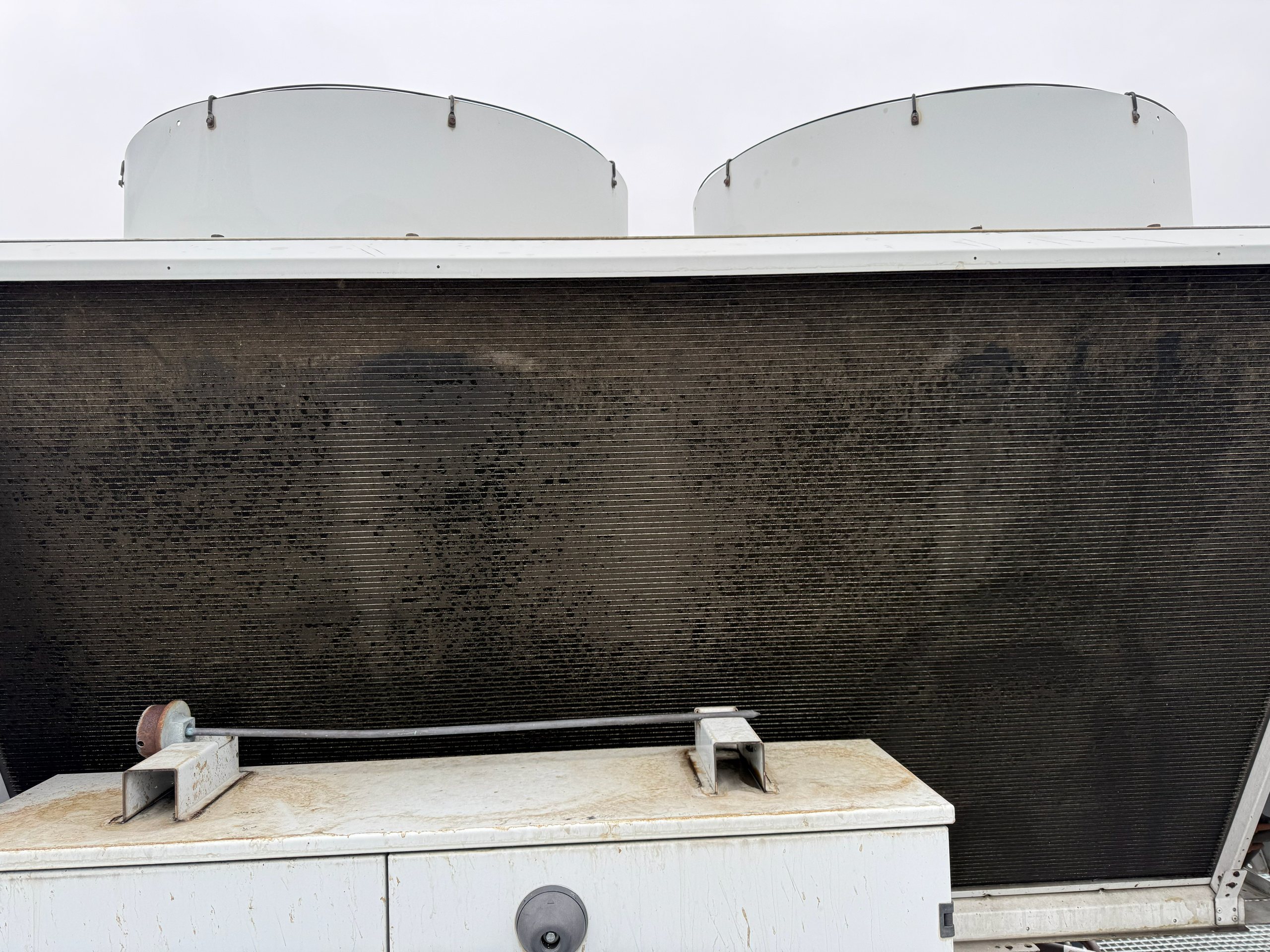
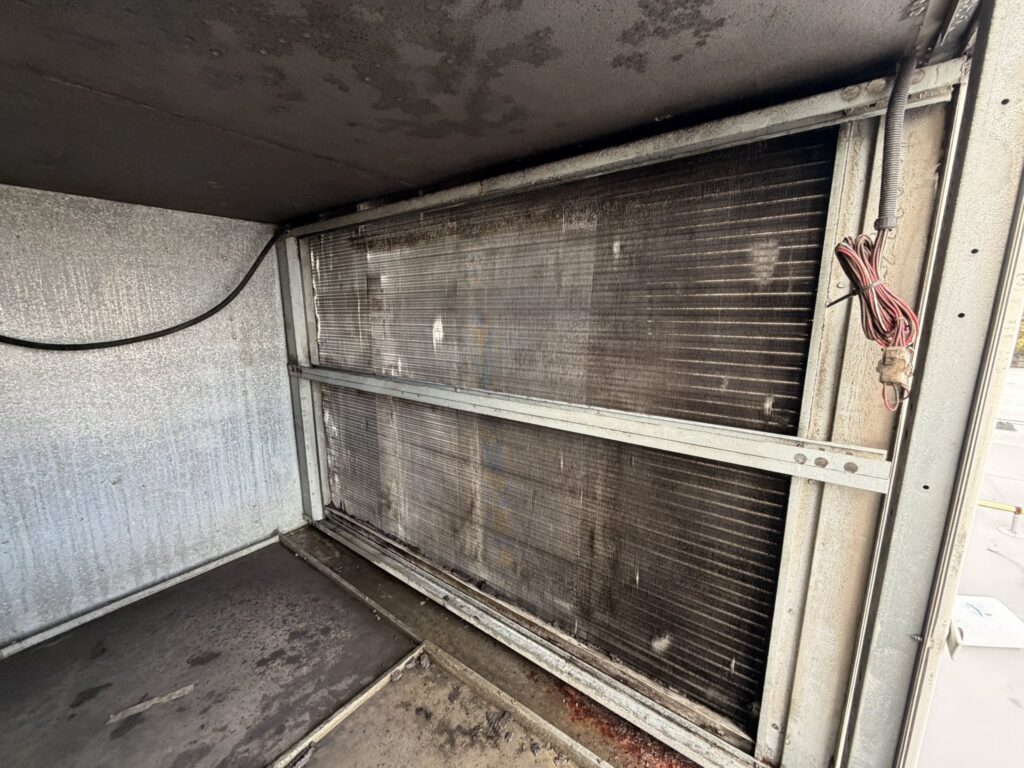
The outdoor coil of a rooftop unit fouls faster than many people expect, especially on buildings near roads, fields or kitchen exhausts. A fouled coil means high pressure trips in summer and poor defrost in winter.
Heating section and safety devices
Rooftop units heat with the heat pump circuit, an electric heater, a hot water coil or a gas burner section. Each needs its own checks.
| Heating type | What we check | Typical faults |
|---|---|---|
| Heat pump mode | Capacity, defrost, four-way valve, supply air temperature | Iced outdoor coil, failed defrost sensor, internal valve leakage |
| Electric heater | Current per stage, contactors, high limit thermostats | Burnt elements, tripped manual reset thermostat after fan failure |
| Hot water coil | Valve operation, frost protection thermostat, glycol | Frozen coil, stuck valve, air in the coil |
| Gas burner section | Ignition, flame monitoring, high limit, combustion air pressure switch | Lockouts, failed ignition electrode, blocked flue path |
For gas-fired sections we inspect the burner and its safety chain. Adjustment of gas settings in Germany is coordinated with a locally registered gas installer where national rules require it. Safety devices are tested by simulation, for example by stopping the supply fan and checking that the heater is switched off by the airflow switch.
Fans, belts, dampers and filters
The air side decides whether the unit delivers its capacity to the building.
- Supply and return fans: current, speed, bearing noise and vibration. On belt-driven fans we check tension and alignment and replace worn belts and pulleys.
- EC fans and inverters: fault memory, set speeds and control signals.
- Outdoor air, return air and exhaust dampers: actuator travel, linkages, seals. A damper stuck open in winter is a common cause of frozen coils and cold buildings.
- Filters: pressure drop against the recommended final value, correct fit in the frames so air does not bypass them.
- Condensate tray and drain: cleaning, trap function, heating of the drain in winter where fitted.
Controller alarms and settings
Rooftop controllers store a lot of useful information. Before touching anything we read the alarm history and the operating parameters. Repeated low pressure alarms in the morning point to a different cause than high pressure alarms in the afternoon. We then check:
- Setpoints for cooling, heating and supply air limits against the building’s actual needs.
- Sensor readings against a reference thermometer, including outdoor, return, supply and coil sensors.
- Time schedules and the interface with the building management system.
- Economiser (free cooling) logic and the minimum outdoor air position.
- Firmware and controller faults that require a replacement board or display.
Badly set controls are behind many complaints about rooftop units, from cold zones near doors to compressors starting too often. Correcting them often costs less than any spare part.
Inspection and repair visits
We work on rooftop units in Poland, Germany and other EU countries. A typical inspection covers all sections listed above, with cleaning of the outdoor coil when needed, which is described further on the condenser cleaning page. You receive an electronic report in English with measurements and photos, signed on site. Repairs follow the report, with a quote first. Safe access is a condition of the work: roof edge protection or anchor points, and a crane or lift for heavy parts, agreed before the visit.
Frequently asked questions
How often should rooftop units be serviced?
We recommend two visits a year: one before the cooling season and one before the heating season. The leak check interval depends on the refrigerant charge and may require additional visits.
Do you work on all rooftop brands?
Yes, we are independent and work on all brands after the warranty has ended.
Can you replace a compressor on the roof?
Yes, scroll compressors in rooftop units are usually replaced on site. Lifting equipment and access are agreed in advance.
The unit heats badly in frost. What is the usual cause?
On heat pump units it is most often defrost problems or a fouled outdoor coil. On other units, look at outdoor air dampers that do not close and frost protection trips.
Rooftop units ready for the next season?
Send us the number of units, the models and the site address and we will plan an inspection.