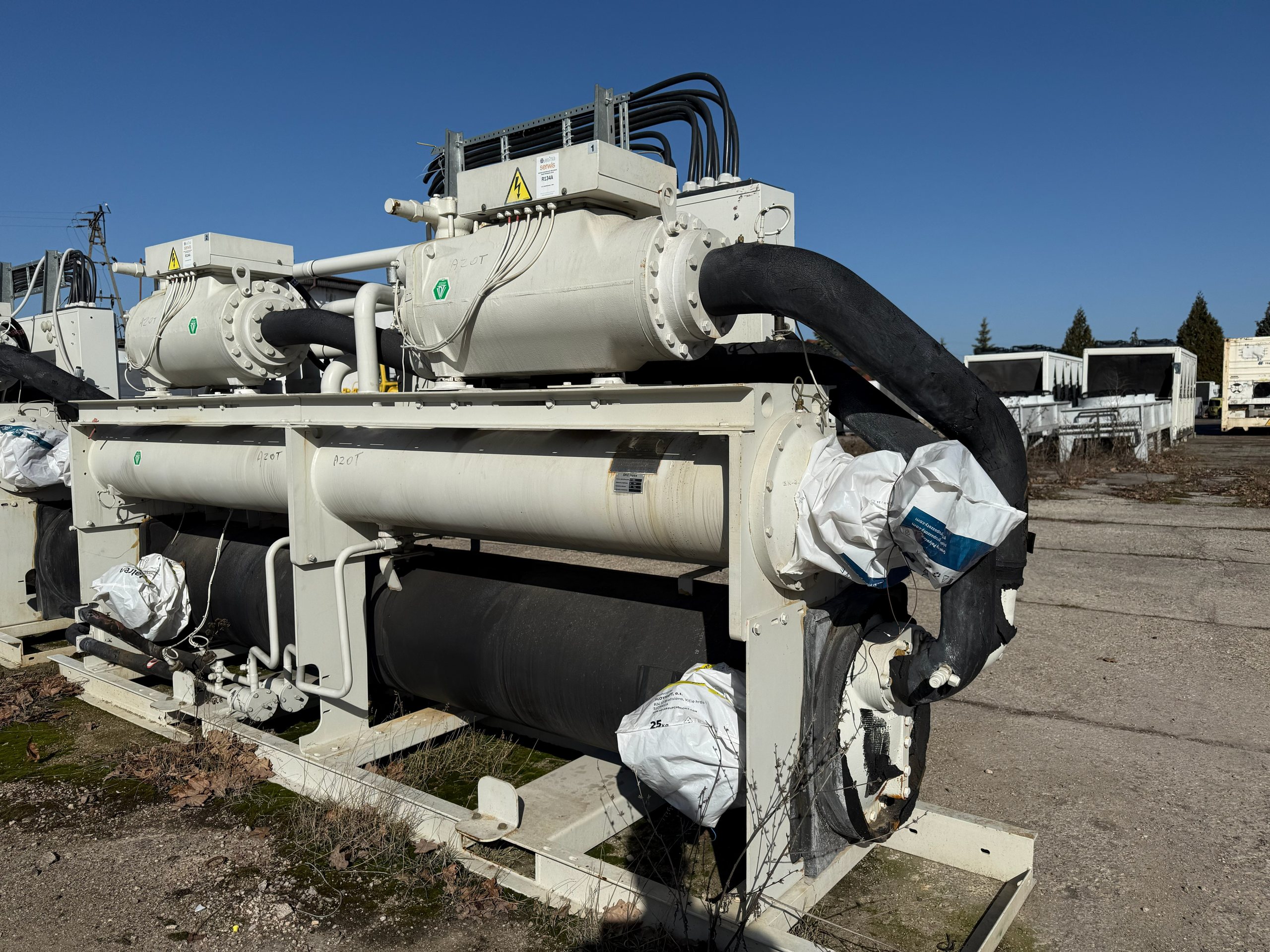
When a chilled water unit stops in an office building, hospital, hotel or plant, the problem is not only the unit: it is warm offices, warm operating theatres or a stopped process. We find out whether the cause lies in the refrigerant circuit or on the water side, repair it and tell you honestly when modernisation makes more sense.
Chilled water units serving buildings usually run for many hours at part load, with long pipe runs, many consumers and control valves that change the flow all the time. That makes their faults different from a process chiller next to a single machine. A large share of the call-outs we see are caused by the water system around the unit, not by the unit itself.
High pressure faults
High pressure trips are the typical summer fault. The unit cannot reject heat fast enough, the condensing pressure rises and the high pressure switch stops the compressor. On an air-cooled unit we compare the condensing temperature with the ambient air temperature: a difference of 10 to 15 K at full load is normal, 20 K or more means a problem.
- Fouled condenser coils: pollen, dust, leaves and grease from kitchen exhausts on hotel roofs.
- Failed condenser fans or a fan speed controller that holds the fans at low speed.
- Hot air recirculation when the unit stands too close to a wall or under a canopy.
- Overcharge after a previous service, or non-condensable gases after a poorly evacuated repair.
- On water-cooled units: fouled condenser tubes and too little flow from the cooling water circuit.
Low pressure faults
A low pressure trip means the evaporating pressure has fallen below the set limit. The most common causes are a refrigerant leak, a faulty expansion valve, a blocked filter drier and, very often in buildings, too little water flow through the evaporator. With low flow the water leaving the evaporator gets colder, the refrigerant evaporates at a lower temperature and the frost protection or the low pressure switch stops the unit.
Capacity loss and fouled heat exchangers
A unit that runs continuously but cannot hold the supply temperature has lost capacity somewhere. The approach temperature of the evaporator tells us a lot: the difference between the leaving water temperature and the evaporating temperature. On a clean plate heat exchanger it is typically 2 to 4 K, on a shell and tube evaporator 3 to 5 K. When this value doubles, the heat exchanger is fouled on the water side, short of refrigerant or starved by the expansion valve.
Plate heat exchangers in building systems foul with magnetite sludge, debris from new pipework and products of glycol degradation. Depending on the design we clean them chemically in place or recommend a filter on the return line to stop the problem returning.
Water side problems: flow, pumps and strainers
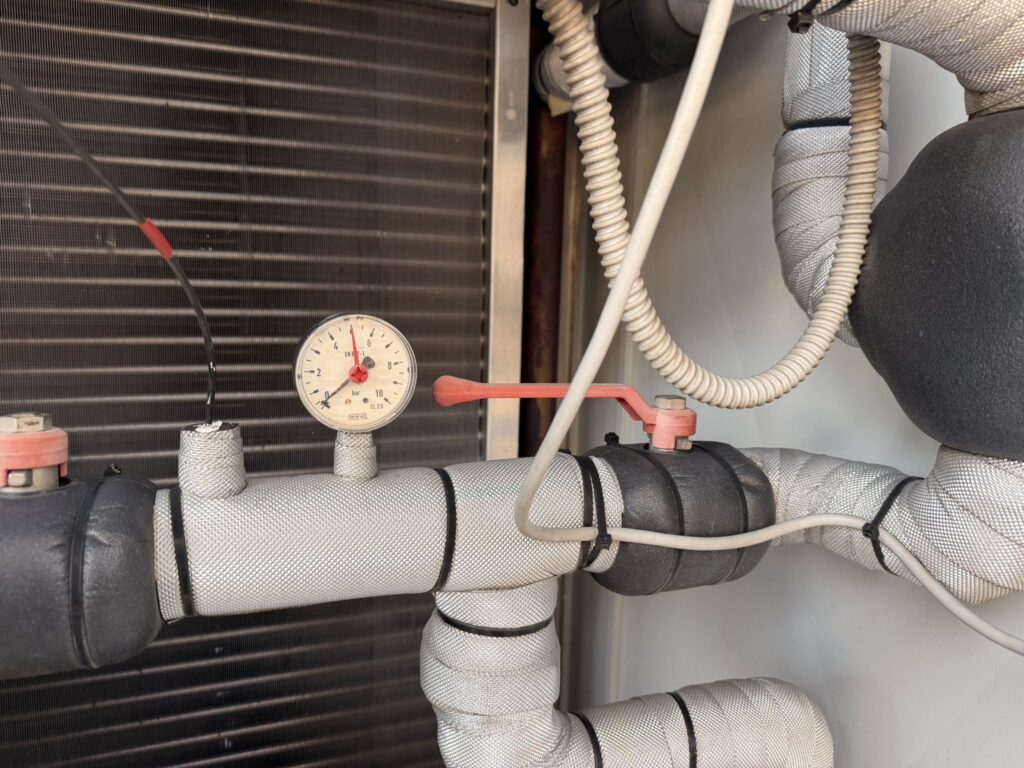
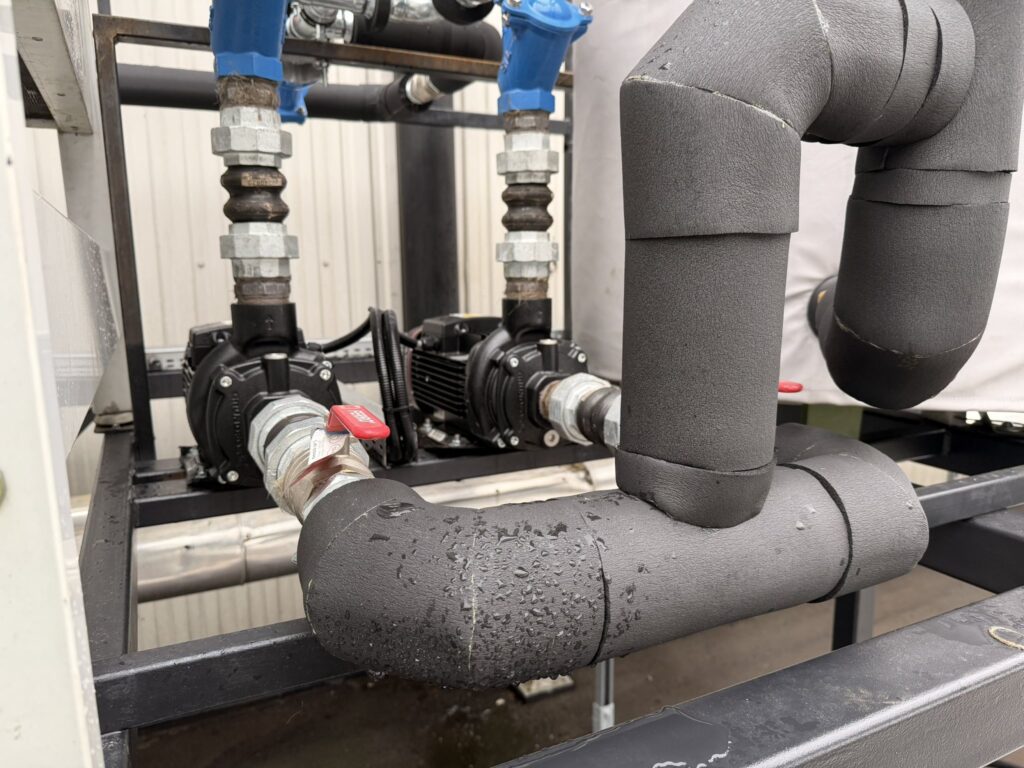
Building systems change over the years. New consumers are added, two-way valves replace three-way valves and the original pump no longer matches the system. We measure the pressure difference across the evaporator and compare it with the manufacturer’s curve to find the actual flow.
| Measurement | Typical design value | What a deviation suggests |
|---|---|---|
| Supply and return temperature difference | 5 K (for example 7/12 or 6/11 degrees C) | Below 3 K: too much flow or low load. Above 7 K: too little flow |
| Pressure drop across the evaporator | According to the manufacturer’s curve | Too low: low flow. Rising over time: fouling |
| Strainer pressure drop | A few kPa when clean | Blocked strainer, often after works on the pipework |
| Static pressure of the system | Set to the building height plus a safety margin | Pressure loss: leak or failed expansion vessel, risk of air entering |
We also check the pumps, the flow switch setting, the expansion vessel pre-charge and the venting. Air in the system causes noisy pumps, unstable flow and corrosion. Glycol systems get a concentration and pH test, described in more detail on our glycol testing page. The installation side itself, including new pipework and buffer tanks, is covered under chilled water installations.
Repair or modernisation
After the diagnosis you receive a report in English with the measurements, photos and our recommendation. For older units we compare three options:
- Repair of the fault found, when the rest of the unit is in good condition.
- Modernisation: for example new controls, electronic expansion valves, EC fans or a compressor upgrade on a sound frame and heat exchangers.
- Replacement, when heat exchangers are corroded, parts are no longer available or the refrigerant is becoming hard to obtain. New and refurbished units are available through our group company ChillerTech.
We give you the costs of each option, so the decision is based on numbers and not on guesswork. Where the unit is critical, for example cooling for a hospital or a data room, we also discuss a temporary unit for the time of the work.
Frequently asked questions
Our unit trips only on hot afternoons. Is that a refrigerant problem?
Usually not. Afternoon high pressure trips are most often caused by a fouled condenser, a weak fan or hot air recirculation. We confirm it by measuring the condensing temperature against the ambient temperature at high load.
Can you work while the building is in use?
Yes. Most diagnostics and many repairs are done with the building in operation. Work that needs a shutdown is planned with you in advance.
Do you service the air conditioning terminals in the building as well?
No. We work on the chilled water unit and the water system around it. We do not service split or VRF systems or fan coil units.
How do we prepare for your visit?
Send us the nameplate data, the alarm history if available and a description of when the fault occurs. Access to the unit, the pumps and the electrical panel saves time on site.
Chilled water unit not keeping up?
We will find out whether the cause is in the unit or in the water system and propose a fixed price for the diagnosis.